Restoring a lost Tucson landmark through a mid-century lens.
February 2026.
Tucson, Arizona.
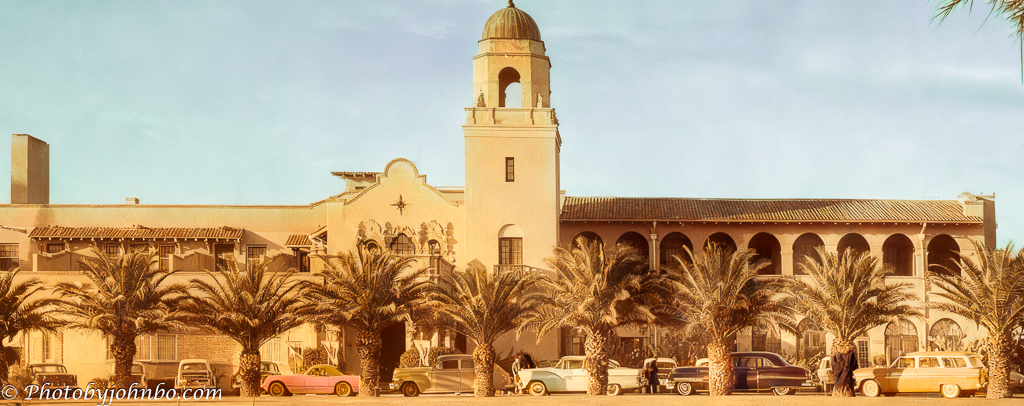
They say you shouldn’t go to a museum just to look at the walls, but at the Tucson Wagon and History Museum, I found myself doing exactly that. Hovering above a vintage hotel desk is a mural that acts as a portal to 1950s Tucson, featuring the long‑lost El Conquistador Hotel. While most visitors were admiring the saddles and stagecoaches, I was framing up a shot with my Nikon Z7 II, drawn to the mid-century steel lined up in the driveway. This wasn’t a “Cellpic Sunday” moment; the architectural lines of that iconic copper‑domed tower and historic automobile collection demanded the resolution only a full‑frame sensor could provide. What started as a historic reference photo turned into a deep dive into restoration and colorization—bringing a splash of “Old Tucson” sun back to a landmark that’s been gone since 1968.
In this post:
The Restoration: Bringing a faded 1950s hotel mural back to life using a mix of Nikon resolution, Luminar Neo’s AI, and some surgical HSL panel work.
The Automobile Digression: A high-resolution deep dive into the hotel’s driveway—from the final days of the structural “Woodie” to the artistic decision to “upgrade” a ghostly Corvette to 1954 Sportsman Red.
The History & Mystery: Exploring the origins of the iconic El Conquistador Hotel and the detective work behind identifying the mystery photographer who captured Tucson’s mid-century elegance.

Bringing the Image Back to Life
I’d already taken a couple of photos of the hotel lobby diorama when a docent struck up a conversation, pointing out that the sconces beneath the mural once hung in the condo clubhouses on the hotel grounds. The mural itself features the hotel in its heyday, reproduced from an old photograph. I briefly considered pulling out my cellphone to capture its details, but chose the Nikon instead. I didn’t think about restoring the mural image until I saw it again while processing my museum shots. I quickly cropped a virtual copy of the photo above and spent some time in the Transform module, straightening and leveling the image.

I straightened the crop in Adobe Lightroom Classic and tried to address the strong shadow cast by a light falling across the sky and the area to the right of the tower. Cleaning up the sky turned out to be the easy part; dealing with that heavy shadow along the hotel’s right side was another story. Every attempt to lift it—radial filters, brushwork, even a linear gradient—left the image looking worse, not better. In the end, I left the dark area alone and hoped Luminar Neo’s restoration tools would handle it more gracefully.

Before sending the photo for restoration, I cleaned up a few dark patches in the sky but left the scratches intact—Luminar Neo’s Restoration module excels at handling those. I used the Remove tool to smooth some of the rough edges along the frame, then sent the image to Neo for a Full restoration. The tool offers three options—Full, Color, and Scratches—and while the Full restoration was impressive, Neo’s AI decided to plant several palm trees across the image, completely obscuring it. One thing I’ve learned about this module is that if you don’t like the first result, run it again. On my second attempt, I chose Scratches, and it did a much cleaner job: the sky came back nicely, and the dark area to the right of the tower lightened just enough. And honestly, with the tower casting its own shadow, some of that darkness may have been part of the original scene anyway.

I then dropped the black‑and‑white restoration into the Restoration module and selected the Color option. The mural’s strong sepia tone gave the image a natural, vintage feel, so I kept it; it reinforces the 1950s aesthetic. I was relieved to see that Neo’s AI palm trees didn’t make a return appearance. With the color pass complete, I started noticing the wealth of now‑classic mid‑century automobiles lined up in front of the hotel. As I dug deeper into the history of the original photograph, I even uncovered a promising clue about the photographer’s identity.

Digital restoration is always a bit of a tug‑of‑war between human judgment and machine interpretation. Neo gave me a solid starting point, but its palette leaned heavily toward sepia, and the sky had collapsed into a muddy gray. I began by using Neo’s Remove Color Cast tool to neutralize the sepia tone, which immediately brought the stucco back to a more believable mid‑century hue—though it left the sky looking flat and lifeless. With a mask isolating the sky, I turned to the HSL panel to coax that unmistakable Arizona blue back into place while softening the saturation to honor the film styles of the day. Wanting to preserve the understated look of early color film, I masked the trees separately and added just a bit of green.
While the AI provided a decent foundation, it initially left the 1953–54 Corvette in a ghostly, flat gray. It took some surgical work in the HSL panels to land on a period‑appropriate Sportsman Red—something that felt like genuine 1950s lacquer rather than a modern digital overlay. And since the first 300 Corvettes in ’53 were only offered in Polo White, brushing this one red effectively “upgraded” it to a 1954 model. Call it restoration; call it evolution; call it artistic license—I simply think it looks better in red.
A Closer Look at the Driveway

I hope it’s allowable for me to digress from within a digression. Given the high megapixel resolution of my Z7 II, I zeroed in on the classic cars parked in front of the hotel. That’s easy for me, being a “Classic Car” nut. These weren’t classics; they were daily drivers in their day.
The 1940s Woodie (Left): A weathered post-war workhorse that represents the end of the true structural wood-bodied era. It looks humble and a bit tired compared to its flashy resort neighbors.
The 1953–1954 Chevrolet Corvette (Center): Originally a flat gray in the colorized version, I gave this fiberglass disruptor the “Sportsman Red” soul it might have carried in its second year of production.
The 1949–1952 Chevrolet Fleetline (Right): Sporting its signature “fastback” silhouette, this car represents the final peak of aerodynamic “streamline” styling before the upright, finned look of the mid-50s took over.

The Buick Roadmaster (Left behind the lady): Only a glimpse of the trunk is visible, but the heavy chrome suggests a sturdy 1950s Buick—a model a college friend once affectionately dubbed the RoadToaster for his tendency to make it ‘burn rubber’.
The 1953 Cadillac Series 62 (Center): Zooming in reveals those unmistakable chrome “eyebrows” and massive Dagmars (bumper bullets). This was the undisputed king of the 1950s resort driveway.
The 1952–1954 Ford Ranch Wagon (Right): A clean, modern contrast to the old woodie on the far left; this all-steel wagon heralded the future of the American family road trip and the demise of the timber-framed era.
The Hotel Behind the Cars—and the Mystery Behind the Mural
The original Hotel El Conquistador opened in 1928 at Broadway and Country Club. This Spanish Revival showpiece quickly became one of Tucson’s most recognizable landmarks, thanks to its copper‑topped tower, arched colonnades, and improbably lush gardens. Through the 1940s and ’50s, it thrived as a winter‑sun destination, hosting travelers, social events, and the growing wave of postwar tourism that put Tucson on the map. But as the city expanded eastward and commercial development reshaped the area, the hotel’s fortunes faded; it closed in 1968 and was soon demolished to make way for the El Con Center, a shopping mall. Today, only photographs—and the occasional mural—preserve the memory of a resort that once defined Tucson’s mid‑century elegance.
Before going any further, it’s worth noting that the El Conquistador Resort in nearby Oro Valley has no connection to the original hotel. The only surviving link to that long‑lost landmark is a handful of photographs, including the one that inspired the mural. Tracking down who actually took that photograph is trickier than it sounds, but a few likely contenders emerge once you look at who was shooting Tucson landmarks in the early 1950s. My research suggests four possibilities.
Jack Sheaffer:
He was everywhere. If this photo was originally taken for a newspaper feature (like the Arizona Daily Star) or a local business advertisement, he is the most probable author. His work is archived extensively at the Arizona Historical Society.
Bob Petley (Petley Studios):
If the photo feels “staged”—meaning the cars are perfectly spaced, and the lighting looks like it was chosen for a travel brochure—it’s likely a Petley. He specialized in that “Wish You Were Here” luxury aesthetic.
Ray Manley:
Manley was a world-famous commercial photographer based in Tucson who specialized in “lifestyle” shots featuring modern cars against beautiful architecture. He was often hired by car companies and luxury resorts specifically to showcase the “American Dream” on wheels.
Howard “Howie” Fischer:
Fischer was another prolific Arizona Daily Star photographer active in the early 1950s. He covered everything from civic events to architectural features and was known for straightforward, documentary‑style compositions. If the photo feels more like a news assignment than a commercial shoot—clean, factual, and unembellished—Fischer belongs on the shortlist.
My guess:
After weighing the styles, the era, and the kinds of assignments each photographer was known for, the evidence leans toward Jack Sheaffer. The composition feels more like a straightforward architectural feature than a staged commercial postcard, and that was Sheaffer’s wheelhouse in the early 1950s. He was actively documenting Tucson landmarks during the exact window suggested by the cars, and countless unlabeled mid‑century images that survive today—especially those that ended up in municipal or museum collections—trace back to the Arizona Daily Star archives, where Sheaffer was a dominant presence. I can’t say with absolute certainty that he pressed the shutter, but if I had to place a bet, his name rises to the top.
In the end, restoring this photograph became more than a technical exercise. It turned into a small act of preservation—of a hotel that no longer stands, of a moment when Tucson was finding its mid‑century stride, and of a photograph whose author may never be definitively known. Whether it was Sheaffer or one of his contemporaries, someone stood on that driveway in the early 1950s and captured a scene that still speaks across the decades. I’m simply grateful to have spent a little time with it, bringing its colors, its cars, and its history back into the light. If you’d like to take a closer look at the images in this post, you can view them in 2K HD via Flickr here.
John Steiner
 Journeys with Johnbo
Every time I see or hear the word Conquistador I think of the Procol Harem song
I wasn’t a big fan of their music, but I did enjoy their symphonic take. I don’t remember El Conquistador, but Whiter Shade of Pale was one of my favorites, and I remember Salty Dog.
I guess prog-rock wasn’t for everyone
Nice restoration, fun fact filled tour and beautiful postcard setting with the hotel, trees, and classic cars. Well done John!
Thanks, Brad! I had fun doing both the restoration and the history post.
Wow John, I’m sure you had fun restoring this photo. You brought it back to life! And gave us the history to go along with it.
I really enjoyed this project, and it’s the longest blog post I’ve ever written. That’s not a harbinger that all of them will be this long now. >grin<
😊
You know I’m always very interested in your descriptions of detailed editing work like this, and also always in admiration of your patience! The result is really excellent. Have you thought of sharing it with the museum?
Thanks for your compliment, Sarah. No, I haven’t. I plan to stop again to see if they happen to know the photographer. If i find that out, I will update the post.
What a great place to visit! Beautiful images. The restoration in Neo was excellent.
Thanks, Egidio! I had great fun in the restoration process, especially when I discovered that trove of classic cars then daily drivers.
Have to put this place on my Tucson to-see list, John. Thanks.
The museum is a fascinating look at old Tucson, and the story of the hotel’s past was my favorite of the visit, despite all the wagons from over a century ago. They close for the season in April, but I have a full post about the museum scheduled for November, about a month before they reopen for the 2026-27 season.
Thanks for your faithful reproduction and your detailed listing of the autos!
Thank you for taking the time to read my longest post ever.
Well, John, you hit four of my interest areas: classic cars, photography, Texas and architecture!