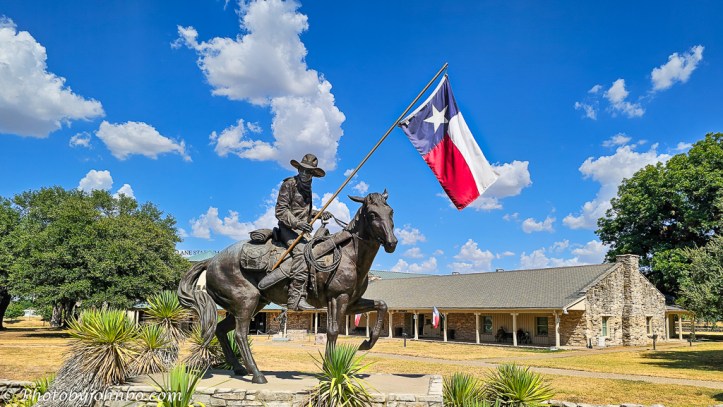
September 2023.
Waco, Texas.
Situated on the banks of the Brazos River, the Texas Ranger Hall of Fame and Museum in Waco stands as a powerful tribute to one of the most storied law enforcement agencies in American history. Established in 1968 near the historic site of Fort Fisher, this museum honors the Texas Rangers’ service over two centuries. These guardians of frontier justice are enduring symbols of resilience in the Lone Star State’s mythology. Our visit to the museum and Hall of Fame revealed stories of heroism and service to the people of Texas.

This exhibit at the Texas Ranger Museum brings history to life with a full-scale figure of a Ranger on horseback, set against a painted backdrop of rugged terrain. At its heart is the “Six Flags Over Texas” display, a visual timeline of the six sovereign nations that have governed the region: Spain, France, Mexico, the Republic of Texas, the Confederate States of America, and the United States. The display vividly illustrates how law enforcement adapted to the changing political landscape. It serves as a reminder that the story of the Texas Rangers is inextricably linked to Texas’s broader history.

The Texas Ranger Hall of Fame and Museum in Waco is divided into two distinct yet complementary sections that honor the Rangers’ legacy. The museum wing, named after Col. Homer Garrison Jr., showcases a rich collection of artifacts, weapons, uniforms, and interpretive exhibits that trace the evolution of the Rangers from frontier scouts to modern law enforcement personnel.
Homer Garrison Jr. served as the longest-tenured director of the Texas Department of Public Safety and the Texas Rangers, holding the position from 1938 until he died in 1968. Under his leadership, the Rangers transitioned into a modern law enforcement agency, striking a balance between their frontier legacy and evolving investigative techniques and professional standards. His commitment to both operational excellence and institutional memory left a lasting imprint on the force and its place in Texas history.

Adjacent to it, the Hall of Fame, established during the American Bicentennial in 1976, commemorates Rangers who demonstrated exceptional valor or made lasting contributions to the force. This solemn space features portraits, biographies, and memorials, offering visitors a deeper appreciation of the individuals behind the legend and the enduring ideals they represent.


Among the many storied figures honored in the Texas Ranger Hall of Fame, Frank A. Hamer stands out as a symbol of frontier tenacity and modern resolve. His role in ending the Bonnie and Clyde saga cemented his national reputation. Still, his decades-long career reveals a more profound legacy: one of quiet courage, moral conviction, and an unwavering commitment to justice.

Manuel T. Gonzaullas, known as “Lone Wolf,” was a trailblazing Texas Ranger whose career spanned some of the most turbulent decades in state history. Born in Cádiz, Spain, in 1891 to American parents, Gonzaullas served as a major in the Mexican Army and a U.S. Treasury agent before joining the Rangers in 1920. He quickly earned a reputation for fearless solo operations, taking on bootleggers, gamblers, and smugglers in oil boom towns and border regions. His nickname reflected both his solitary style and his relentless pursuit of justice—he often rode alone, armed with twin pearl-handled revolvers and a sharp sense of duty.

After a political shakeup led to his dismissal in 1933, Gonzaullas returned to prominence as the first American of Spanish descent to become a Ranger captain. He later led the Bureau of Intelligence within the newly formed Texas Department of Public Safety, establishing one of the nation’s top crime labs. In 1946, he investigated the infamous Phantom Killer case in Texarkana, further cementing his legacy.

In the fall of 1838, a group of 23 Texas surveyors and Rangers working in what is now Navarro County was ambushed by a coalition of roughly 300 Native warriors from the Tawakoni, Waco, Caddo, Ionis, and Comanche tribes. After a series of peaceful encounters, the Texans were caught off guard as they resumed their work in an open field. The attackers had taken strategic positions along the tree line, forcing the Texans to retreat to a grove for cover.
A group of about 50 Indians rode onto the battlefield. They called out to the Texans, saying, “Come to Kickapoos, Kickapoos good Indian!” The Texans were skeptical, but an 82-year-old man named Mr. Spikes volunteered to ride out and see if the Indians were truly friendly. He rode toward the Kickapoo, gesturing in a friendly manner. Before he could go more than a few yards, they opened fire and killed him.

John Reynolds Hughes (1855–1947) was one of the most celebrated figures in Texas Ranger history, renowned for his relentless and unwavering pursuit of justice. His legendary status was cemented in 1886 when he single-handedly tracked down a group of horse thieves across multiple states. This feat of grit and determination led him to join the Texas Rangers, where his quiet demeanor and fearless resolve made him a powerful force against outlaws. His exploits were so famous that he is widely considered the real-life inspiration for the iconic character of the Lone Ranger.
We spent more time at the museum than we thought we might, drawn by tales of frontier grit and legendary lawmen. The Texas Ranger Hall of Fame and Museum provides a compelling journey through time. As of this writing, the museum and Hall of Fame are open daily from 9:00 a.m. to 5:00 p.m., welcoming guests to explore its exhibits, research center, and gift shop. Visit their website here to confirm the details for your visit. As the official state repository for Ranger heritage, the museum not only preserves the past but also invites you to walk alongside it.
About the photos: Photos were processed in Adobe Lightroom Classic and Luminar Neo. AI was used to remove reflections of people in front of the glass-covered exhibits. All images are viewable in 2K HD on my Flickr gallery, here. A few additional photos are available in the gallery not displayed here. The collection includes images captured with both my Nikon D500 camera and Samsung S23 Ultra smartphone. Most have been cropped for display purposes. The accompanying information was generally sourced from placards located next to the exhibits.
John Steiner
 Journeys with Johnbo
Great tour and history lesson John.
Thanks, Brad!
Thanks for the tour and wonderful history John!
Thank you, Anne!
😎
😎
😎
John, ever since reading “Lonesome Dove” and seeing the mini series multiple times I have been interested in the history of the Texas Rangers. Thank you for teaching me a little more about their history. I don’t know how we missed Waco when we wandered around Texas a few years ago.
It was a real learning experience for us, and I wish we had more time to explore the stories in greater depth like I did with the Phantom of Texarkana.