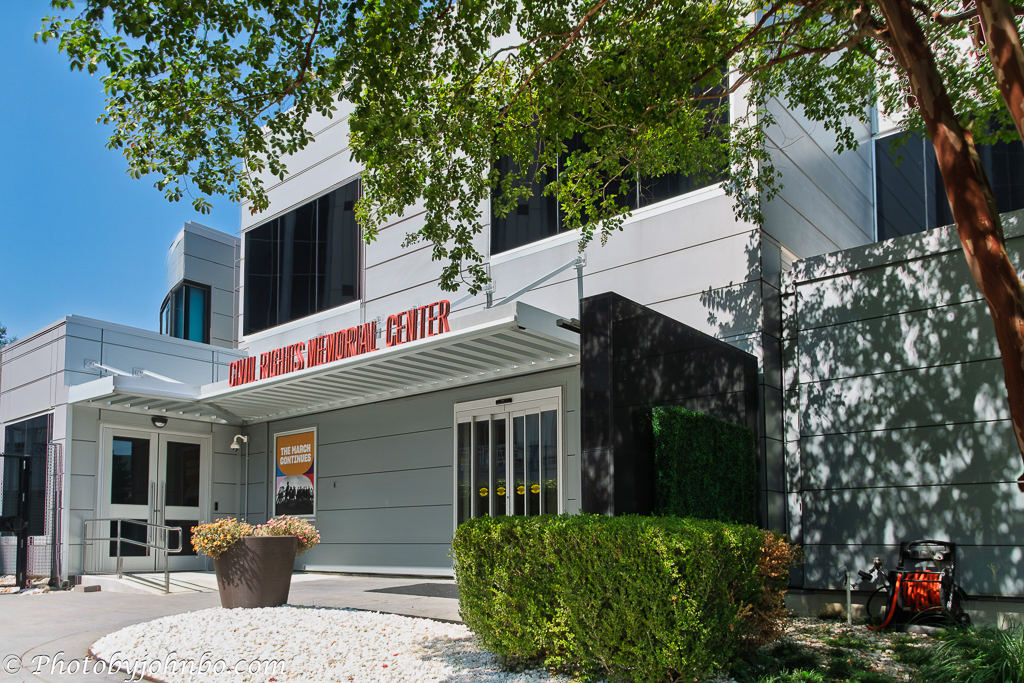
September 2023.
Montgomery, Alabama.
In the heart of Montgomery, Alabama, the Civil Rights Memorial Center, an entity of the Southern Poverty Law Center, offers a solemn yet stirring tribute to the martyrs of the modern Civil Rights Movement. Just steps from the Alabama State Capitol and the Dexter Avenue King Memorial Baptist Church, the museum invites visitors into a space of reflection, education, and resolve. Our visit began at the Center’s entry, where the sleek architecture and landscaped entry hinted at the care and purpose within.

Inside, state-of-the-art exhibits and a powerful short film guided us through the triumphs and tragedies that shaped a nation’s conscience. The wall features a collage of black-and-white photographs and documents that chronicle the events and figures of the civil rights era, specifically from 1954 to 1968. The exhibit uses these archival images to provide an overview of the violence and racism of the Jim Crow era that led to the deaths of the martyrs honored at the memorial. The content on the wall, including photos of key events and individuals, was part of a projection-mapped film that played in the room, creating an immersive experience for us.

These are only a few of the martyrs of the Civil Rights Movement, people who lost their lives in the struggle for justice. Their inclusion grounds the broader historical narrative in the personal sacrifices made by countless individuals. The right side of the mural depicts scenes from the March on Washington, a pivotal event that showcased the movement’s unity and scale.

The display honors the individuals whose names are inscribed on the outdoor Civil Rights Memorial. This photo highlights three of the 40 martyrs honored for their lives lost in the struggle for civil rights between 1954 and 1968.

In addition to the 40, the Civil Rights Memorial Center also has a separate display that honors “The Forgotten,” a list of 74 more people who are believed to have been killed due to racially motivated violence during the same period, but whose deaths lacked sufficient documentation at the time the memorial was created. The placard honoring Johnnie Mae Chappell tells the story of one whose truth will never be fully known.

Though our visit to the Civil Rights Memorial Center took place in September 2023, I am sharing the post in February when the nation pauses to honor Black history, resilience, and progress. Walking through the exhibits, we were reminded that the stories etched into this space are not confined to a single month; they are part of a living legacy that demands ongoing reflection and action. Sharing these photos during Black History Month is my way of amplifying their legacy, honoring those who stood for justice, and paying tribute to the ideals they fought for.
About the photos: The images were captured with a Nikon D500 using multiple exposures, then converted to a tonally blended single exposure in Adobe Lightroom Classic. The low-light images required the use of Adobe Lightroom’s AI noise reduction. Distractions were removed from some photos using AI. The photo metadata and 2K HD images are posted on my Flickr site here.
One final administrative note: Lynn and I are currently on a cruise that severely limits my Internet access. If I don’t respond to comments as quickly as usual, rest assured I’ve read every one and will reply when I can.
John Steiner
 Journeys with Johnbo
Lovely tribute and reminders about those who fought for equality.
Thanks, Brad!
RIP Jesse Jackson.
what’s always bothered me as I’ve grown up is that this struggle is so overwhelming and all encompassing…in this country of Canada we sometimes get smug and brag about the Underground Railroad, but segregation existed here…but in a lot more ways…natives fought here in two world wars before that were considered people and could vote…blacks were excluded from a pool here in a predominately black neighbourhood…and the story of the son of a pullman porter, Oscar Peterson is horrible and then great…we had our own Rosa Parks here, Viola Desmond who now appears on our ten dollar bill…our railroad was built by Chinese men who came here are were treated like crap….racism, intolerance, bigotry…not sure where or how it stops…..but maybe only in the world of Star Trek?
I am afraid you are right. Only in the world of Star Trek!
What a timely post, John! Wonderful photos and information.
Thanks, Egidio!
Thanks, John.