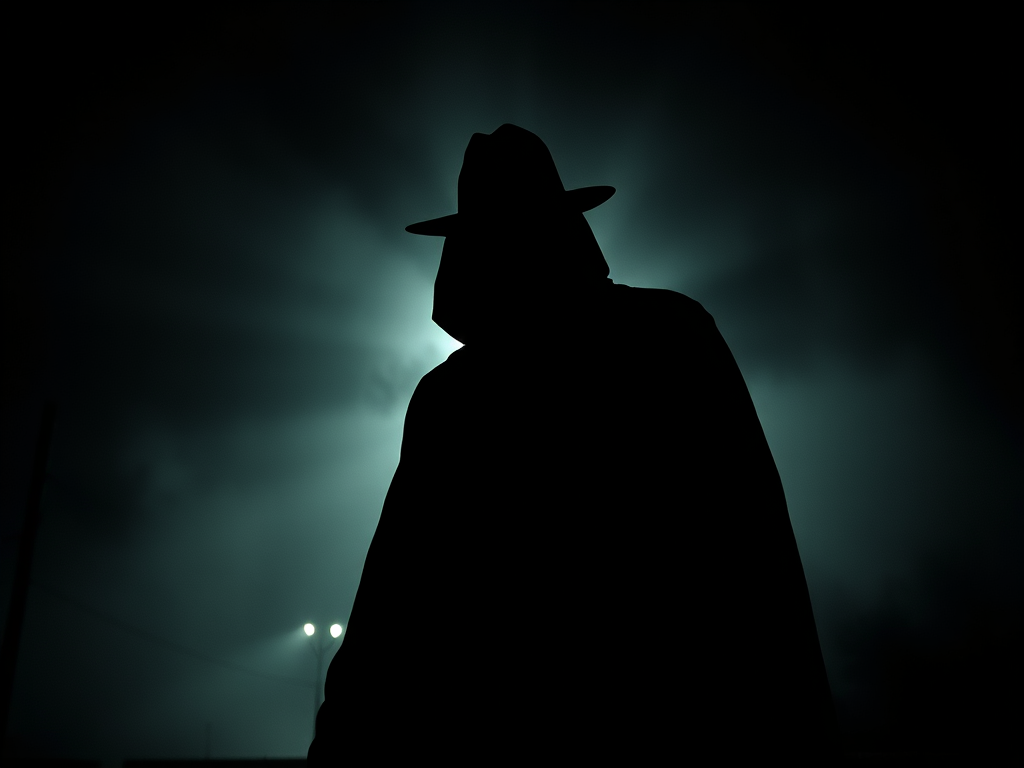
A Story from the Texas Ranger Museum and Hall of Fame
Note: In a couple of weeks, I will share the story of our visit to the Texas Ranger Museum in Waco, Texas. If you are uncomfortable reading the true story of this killer, feel free to move on now.
The museum shared many heroic stories about the Texas Rangers, but this unsolved mystery was the one I found most intriguing. It was there that I learned the story of the Phantom Killer case in Texarkana, which remains one of the most chilling unsolved crime sprees in Texas history. In the spring of 1946, a masked assailant terrorized the twin cities of Texarkana, Texas, and Arkansas, attacking young couples parked in secluded areas. Over the course of several weeks, the killer murdered five people and seriously injured three others, striking with brutal precision and vanishing without a trace. The attacks created widespread panic, prompting curfews, armed patrols, and national media coverage. The perpetrator was never caught, and the case inspired the 1976 cult film The Town That Dreaded Sundown.
The Phantom’s violent spree began on February 22, 1946, with the assault of Jimmy Hollis and Mary Jeanne Larey. The couple, parked on a lonely road, was attacked by a masked man who beat Hollis severely with a gun and then sexually assaulted Larey before fleeing. A month later, two more victims, Richard Griffin and Polly Ann Moore, were found shot to death in their car. The murders continued with the discovery of Paul Martin and Betty Jo Booker on April 14 and the killing of Virgil Starks on May 3. The Phantom, as he was dubbed by the local newspaper, used a .32-caliber pistol in the first three attacks and a .22-caliber pistol in the fourth. Despite a massive manhunt involving local law enforcement from two states, the Texas Rangers, and the FBI, the killer was never identified.

Captain Manuel T. “Lone Wolf” Gonzaullas was a seasoned Texas Ranger known for his investigative acumen and fearless demeanor. Called in to lead the investigation, Gonzaullas brought both his forensic expertise and psychological insight to the case. He worked closely with local law enforcement, conducting interviews with witnesses, analyzing ballistics evidence, and coordinating search efforts. Gonzaullas, who led the Texas Department of Public Safety’s Bureau of Intelligence, had established one of the nation’s top crime labs, and his involvement signified a turning point in the use of forensic science in modern criminal investigations. Despite his considerable efforts and the national attention the case received, the Phantom Killer eluded capture. Gonzaullas later described the case as one of the most frustrating of his career. Still, his role underscored the Rangers’ evolving presence in modern criminal investigations—moving beyond frontier justice into the realm of forensic science and public safety.
The Phantom Killer’s identity remains one of the enduring mysteries of American true crime, and the case stands as a dark chapter in Texas’s history.
This YouTube video provides a summary of the Texarkana Phantom Killer case and some of the theories surrounding it. At first, it appears that the killer was found and never prosecuted, but then, something else blows that theory out of the water.
About the photos: I used the WordPress AI Image Generator to create a cover image for this story. I used the phrase, “Phantom Killer of Texarcana,” as a prompt, but the generator told me that “This request has been flagged by the OpenAI moderation system. Please try to rephrase your post.” When I changed the prompt to “The Phantom of Texarcana”, I got the opening illustration.
The photo of a portrait of Manuel T. Gonzallas was captured with my Samsung S23 Ultra at the Texas Ranger Museum and Hall of Fame. I cropped it to include only his portrait on the sepia matte frame. A couple of lights reflected off the glass surface, but Adobe Lightroom Classic’s Reflection Removal tool didn’t affect them. Fortunately, they were small bright lights and were easily removed with Lightroom’s removal tools. I did no other processing to the photo.
I invite fellow bloggers to join in by creating their own Cellpic Sunday posts. There’s no set theme—the only rule is that your photo must be captured with a cell phone, iPad, or other mobile device. The second rule is simple: link your challenge response to this post or drop a comment here with your link so others can find it. And remember, despite the name, there’s no penalty for sharing on a day other than Sunday.
John Steiner
 Journeys with Johnbo
[…] John’s Cellpic Sunday […]
That is a good crime thriller John
I found the story fascinating, but there are many more stories told in that museum. It’s a wealth of true crime stories.
[…] on. However, after giving it some thought, I realized that it would be perfect to share in John’s Cellpic Sunday. Mobile photography does make it easy to capture these small observations, as it is always […]
History and AI and old photos all in one post. Well done.
Thanks! It is an intriguing story that lacks only a happy ending.
[…] Cellpic Sunday […]
True crime here. Who knew?!
I can’t offer a crime but only a feliny: https://picturesimperfectblog.com/2026/02/08/my-daily-excuse/
Cats have their own “true crime” stories that their owners discover… Trouble is, they are too cute to punish.
😼😽
[…] John’s Cellpic Sunday – 8 February […]
I like the details of the work and service of Captain Gonzaullas. Your photo is excellent, John. I love how you cropped the image and explained the lighting issues you addressed in processing the photo.
Thanks, Suzette. I captured a lot of portraits at the Texas Ranger Hall of Fame, but this story stood out as the one to feature with a Cellpic Sunday among all of the brief stories I saw there. In a few weeks, I’ll share several more stories and Rangers in my Travel Tuesday post about the museum.
You are welcome, John. I love to learn of the history of people who served their community/country. I will keep an eye out for your Tuesday posts. Thank you!
John, that’s a terrifying murder mystery. Thanks for the story about the work of Captain Gonzaullas. Your image of his portrait is great.
Thanks, Beth! Too bad there was never a resolution.
[…] Cellpic Sunday 8 February 2026 […]
[…] for Johnbo’s CellPic Sunday and Lens-Artists: What Astonishes […]
A fascinating look at a true crime, John. My father was raised near Texarkana, TX, in nearby Hooks and lived there until he graduated high school. He would have been old enough to remember the ordeal surrounding the murders. I have visited the area countless times over the years and never heard a thing about this! Unless my cousins tried to scare me with the story and I forgot.
Interesting that AI flagged the image request. Thanks for hosting Cellpic Sunday, here is mine this week:
https://secondwindleisure.com/2026/02/08/sunday-stills-monthly-color-challenge-the-purple-haze-of-amethyst/
That’s an interesting tidbit about your father. Too bad you can’t ask him about the story, I’m sure it was big news at the time.
Thanks for another engaging backstory John. I had no idea of the Phantom or Texas rangers involvement in forensic science.
Thanks, Brad! I found the deep dive into one ranger’s experience to be fascinating.
Me too.
What an intriguing and gruesome story!
Indeed! I found it worthy of a story on one of the reality channels that deep dive into true crime. I’m sure it’s probably been done (in addition to the cult movie I found out about.)
What a chilling story, John. Talk about a cold case. He must have eventually gotten too old to “work” any more. What a scary thing.
It was much earlier than most of the cold cases that have now been solved by re-examining for DNA. It was so interesting to read about when I discovered it in the museum.
I bet. It was interesting to read it on your blog.
[…] For Cellpic Sunday […]
Need another? Here’s mine, Johnbo..https://judydykstrabrown.com/2026/02/08/isidros-studio-for-cellpic-sunday/
Always enjoy seeing other Cellpic Sunday posts!
[…] Cellpic Sunday February 8, 2026: – Silent Sunday […]
How had I not ever heard of this phantom? I am intrigued. Seems like a perfect storyline for a podcast. Thanks for the interesting story. 😊
I hadn’t heard the story either, but my discoveries at the Texas Ranger Museum told me this and many others.
[…] Journeys by Johnbo Cell Pic Sunday doesn’t care what color the photos are as long as they are taken with a cell phone. You can probably tell which is which because these are all older phone photos. […]
[…] John’s Cell Pic Sunday-2026.002.15 […]
What’s the story behind the Phantom of Texarkana – was it a serial killer? 🤔
The murders were never solved! One of the Texas Ranger unsolved mysteries.
[…] Safety, establishing one of the nation’s top crime labs. In 1946, he investigated the infamous Phantom Killer case in Texarkana, further cementing his […]