September 2023.
Montgomery, Alabama.
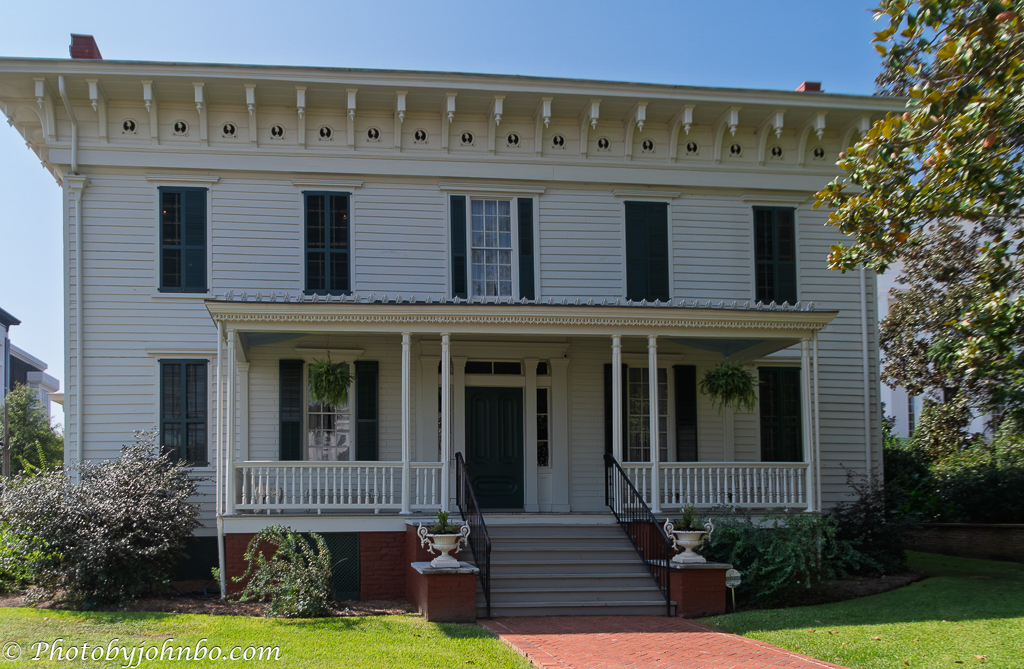
Our 2023 autumn journey led us to a quiet corner of American history in Montgomery, Alabama. One of the places we toured was the First White House of the Confederacy. In early 1861, Montgomery briefly served as the capital of a newly declared Confederacy. Within this modest home, Jefferson Davis lived and governed as its first president. He was surrounded by the trappings of domestic life and the urgency of rebellion. The bracketed eaves and genteel porch suggest Southern grace, but the rooms inside once held the weight of secession, strategy, and uncertainty. Today, the First White House of the Confederacy stands as a museum, restored and interpreted to reflect its brief yet pivotal role in American history. It offers not just a glimpse into the private life of Davis and his family, but a reminder of how division, once formalized, leaves echoes that still shape the present.

As we stepped inside, the tone shifted from political to personal. The formal dining room, elegant and steeped in Victorian detail, presented a glimpse into the domestic life of Jefferson Davis and his family during their brief residence in Montgomery.
Though the First White House of the Confederacy no longer retains its original furnishings, the rooms are carefully outfitted with authentic period pieces that reflect the domestic style of the 1850s and 1860s. When the house was relocated to its current site in 1919, curators undertook a meticulous effort to recreate the ambiance of Jefferson Davis’s brief residency. The result is a historically informed setting that invites reflection on both the personal and political dimensions of the Confederacy’s early days, offering visitors a sense of place shaped as much by interpretation as by preservation.
Around the room, gilded mirrors reflect candlelight from silver candlesticks. Fine china and glassware rest on white linens, as if awaiting guests who would never arrive. From this room onward, each interior space reveals not only period furnishings but also the layered story of a household caught in the early stirrings of war. The photos that follow trace these preserved rooms, inviting reflection on the intersection of comfort, conviction, and consequence.

The first parlor in the museum is furnished in Victorian style, reflecting the tastes and social expectations of the mid-19th-century Southern elite. The parlor was likely used to entertain dignitaries, host musical evenings, and conduct informal political conversations. Its preservation today offers insight into the domestic rituals and public-facing roles of Confederate leadership. The furnishings are consistent with those of the 1850s and 1860s, many of which are carefully selected to match the era, although not original to the house.

The Second Parlor of the First White House of the Confederacy offers a quieter, more contemplative atmosphere than its formal counterpart. Anchored by a portrait of Varina Howell Davis above the fireplace, the room evokes the domestic side of Confederate leadership, one shaped as much by family life as by politics. Varina, known for her intellect and candor, adds a humanizing presence to the space, reminding visitors that this was not just a seat of power but a home. The furnishings suggest a room used for reading, hosting guests, or quiet discussion.

The Study in the First White House of the Confederacy offers a quieter, more introspective counterpoint to the parlor rooms. This was the space where Jefferson Davis met with visitors, read correspondence, and reflected on the weight of his role during the Confederacy’s earliest days. Furnished in the style of the early 1800s, the room features tall bookcases, comfortable armchairs, and a central desk, chosen for both its functional purpose and the impression of authority and refinement it conveys. This room, more than any other, evokes the intellectual and administrative side of Davis’s presidency, where domestic calm and political calculation were woven into a leadership style.

Ascending the staircase to the second floor, we arrived at the Master Bedroom, a space that once afforded Jefferson Davis a measure of privacy amid the demands of leadership. The room is furnished with a four-poster canopy bed, dressed in a patterned coverlet that reflects mid-19th-century textile design. The room’s preserved details speak to the domestic rhythms of a household shaped by history.
The museum is situated opposite the Alabama State Capitol and is open Monday through Friday from 8:00 a.m. to 3:00 p.m. Saturday hours are 9:00 a.m. to 3:00 p.m.; the museum is closed on Sundays and certain holidays. Admission is free, and self-guided tours are available during open hours. Please visit their website here for any updates on operating hours and fees.
About the photos: The photo series was captured with a Nikon D500 paired with a Tamron 16-300mm lens. For the panorama shots of the Bedroom and Second Parlor, I experimented with two- and three-exposure images stitched together using Adobe Lightroom Classic. I used Lightroom’s boundary warp feature to allow the most extensive possible views. Though some distortion is noticeable, I was pleased with the results, as they allowed me to show more detail in these small rooms. Let me know in the comments whether you like the effect or if you find it disconcerting. You can view the entire gallery in 2K HD on my Flickr site here.
John Steiner
 Journeys with Johnbo
This is really interesting, I had no idea there was a confederate White House.
One of the things I learned there is that there was a second one, as well. The confederates moved their capital from Montgomery to Richmond, Virginia in 1861.
Thanks for another glimpse of history John. Great images.
Thanks you, Anne!
Wonderful information. No idea that a White House existed in the south.
I only found it on a Google search for “things to do in Montgomery, Alabama while we were on our way through for an overnight stay on a road trip.