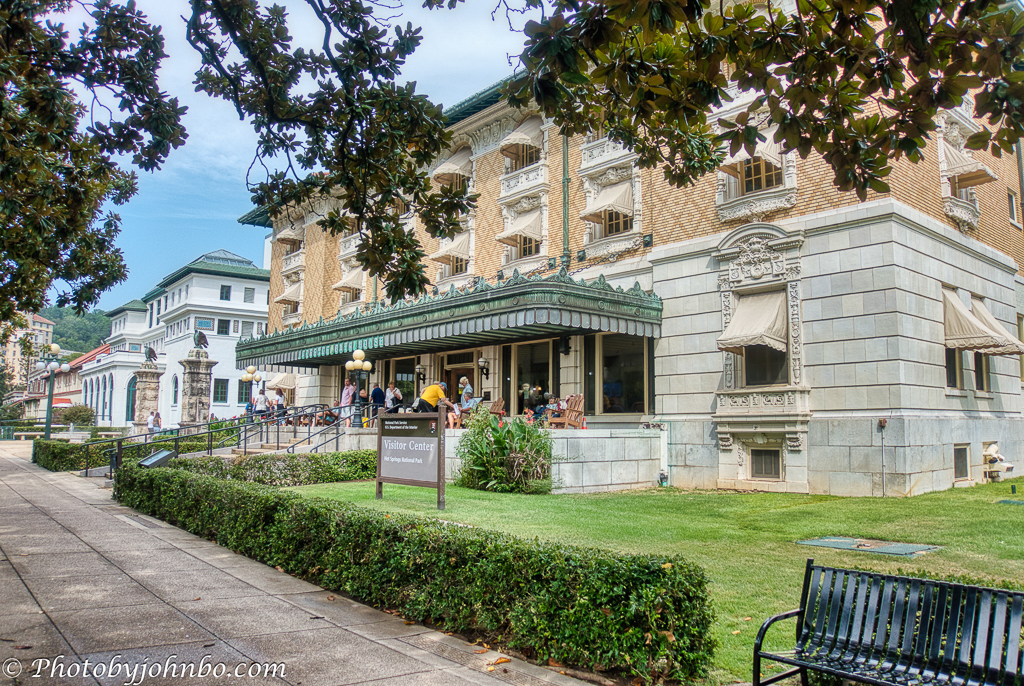
September 2023.
Hot Springs, Arkansas.
Our month-long fall trip in 2023 brought us to Arkansas for our first visit. Though we will not complete our goal of visiting all of the National Parks, we try to add to the list on every fall trip we make. These thermal springs, rich in minerals and naturally filtered through layers of sandstone and dense rock, have drawn visitors for centuries. Initially, they were sought for their healing reputation among Native American tribes, and later, they became a cornerstone of American spa culture. My opening photo features the Fordyce Bathhouse, now repurposed as the Hot Springs National Park Visitor Center. Inside, we found a beautifully preserved museum of spa history: stained glass, marble fixtures, and vintage therapy rooms.

This decorative wall fountain features a ceramic cherub statue seated on a shell, with water spouts below. The fountain is framed by marble columns and an arched niche with tilework and ornamental vases. Originally part of the bathhouse’s hydrotherapy facilities, it reflects the early 20th-century emphasis on both function and aesthetics in spa design.

We walked through the men’s dressing room inside the bathhouse visitor center. At the center is a sculptural fountain depicting Hernando de Soto’s encounter with a Native American, a nod to the region’s early European exploration. Surrounding the statue are individual changing stalls with original wood-paneled doors, labeled alphabetically. The tiled floor, benches, and period furnishings reflect the bathhouse’s emphasis on privacy, comfort, and orderly routine, hallmarks of early 20th-century spa culture. Today, the room serves as a preserved exhibit, offering a glimpse into the daily rituals of bathhouse guests.

This room diorama represents the former men’s massage and pack room, part of the therapeutic regimen offered to guests during the bathhouse’s operational years. The beds were used for various treatments, including massages, steam packs, and electrotherapy. The tiled walls, sink, and simple furnishings reflect the clinical, orderly environment typical of early 20th-century spa medicine. Today, the room is preserved as part of the visitor center exhibit, offering insight into the medicalized approach to wellness that defined Hot Springs’ reputation.

In the visitor center, through dioramas, we also learned about the geology of the hot springs in the mountains behind the thermal spas. The water flows continuously, requiring no mechanical pumping, and is piped directly into the historic retreats along Bathhouse Row. Each structure offers a unique experience, from traditional hydrotherapy at Buckstaff to the communal thermal pools of Quapaw Baths, all sustained by the same ancient geothermal source that made this area the first federally protected land in the United States, even before the National Park Service existed.
As we left the bathhouse, the Fordyce’s stately exterior offered a final view of its ornate façade and historic charm, echoing the stories we’d just explored inside. We started our tour of the bathhouse exteriors with our walk down Central Avenue. Though the photos in this series appear in no particular order, they collectively trace our walk along Bathhouse Row.

The Lamar Bathhouse, seen here with its crisp white exterior and blue awnings, was one of the quieter establishments on Bathhouse Row, catering to guests who preferred a more modest, personalized spa experience. Opened in 1923, it offered traditional hydrotherapy treatments and was notable for accommodating shorter stays and custom services. Unlike some of its more opulent neighbors, Lamar emphasized accessibility and comfort, serving as a welcoming retreat for a broad range of visitors seeking the healing properties of Hot Springs’ thermal waters.

Now home to the Bathhouse Row Emporium, the Lamar Bathhouse serves as a retail space operated by the National Park Service, offering books, souvenirs, and locally inspired gifts that connect visitors to the park’s rich history.

The Buckstaff Bathhouse, shown here with its classical columns and blue-striped awnings, has been a fixture on Bathhouse Row since 1912. It was known for offering traditional thermal treatments, mineral baths, steam cabinets, and massages, using water directly from the hot springs. Unlike many of its neighbors, Buckstaff maintained continuous operation for over a century. In 2023, the building underwent renovation to preserve its historic features while updating its facilities. Despite the construction, Buckstaff remained open to visitors during the remodel, continuing its legacy as the only bathhouse on the Row still offering full spa services drawn from the original geothermal source.

The Ozark Bathhouse, completed in 1922 in the Spanish Colonial Revival style, once catered to middle-class visitors seeking therapeutic soaks without the luxury frills of its neighbors. With its twin towers, red-tiled roof, and distinctive plaster window boxes, it offered 27 tubs across 14,000 square feet, emphasizing practicality over opulence. After closing in 1977, the building underwent restoration to preserve its architectural integrity. Until late 2024, it served as the Hot Springs National Park Cultural Center, showcasing art from the Artist-in-Residence program and rotating exhibitions. As of now, the Ozark stands unoccupied, awaiting its next chapter on Bathhouse Row.

Built in 1922, the Quapaw Bathhouse was the largest on Bathhouse Row, offering thermal baths, massages, and electrotherapy in a grand Spanish Colonial Revival setting. Its signature tiled dome and spacious design exude both elegance and practicality.
After decades of vacancy, Quapaw reopened in 2008 as a modern spa. Today, it offers public thermal pools and private treatments, continuing its legacy with direct access to the natural hot springs.

Opened in 1916, the Superior Bathhouse was the smallest and most affordable on Bathhouse Row, offering basic hydrotherapy and massage services in a modest classical revival structure. It closed in 1983 after decades of serving health seekers drawn to Hot Springs.
Today, Superior has been reborn as the only brewery located in a U.S. National Park—and the only one in the world to craft beer using thermal spring water. Its taproom and restaurant offer a creative twist on the bathhouse legacy, pouring Hot Springs directly into every pint.

A quiet passage between the Maurice and Fordyce bathhouses leads to the Grand Promenade, framed by eagle-topped pillars and manicured hedges. Once bustling with spa-goers, this shaded corridor now offers a serene transition from the architectural grandeur of Bathhouse Row to the wooded trails of Hot Springs Mountain.
Just beyond the eagle-flanked entrance to the Grand Promenade, a network of trails winds up Hot Springs Mountain, offering a blend of urban charm and forested escape. The Hot Springs Mountain Trail loops 1.7 miles around the summit with scenic overlooks and gentle grades, while the Peak Trail climbs steeply to the Mountain Tower for panoramic views of the Ouachita range. Short connectors like the Tufa Terrace and Oertel Trail link the promenade to higher elevations, making it easy to customize a route. Whether a quiet stroll or a vigorous climb, these trails offer a refreshing counterpoint to the historic bathhouses below.

Built in 1892, the Hale Bathhouse is the oldest surviving structure on Bathhouse Row and initially offered hydrotherapy and steam treatments in a Romanesque Revival setting. Its modest scale and arched façade made it a quiet retreat for visitors seeking relief from ailments.
Today, the building operates as Hotel Hale, a boutique inn where guests can soak in thermal spring water directly piped into their room’s tubs. With a cozy café and restored interiors, it blends historic charm with modern comfort in the heart of Hot Springs National Park.

The James Alexander Cary Memorial stands as a solemn tribute to the first U.S. Park Ranger killed in the line of duty. On March 12, 1927, Cary was patrolling West Mountain in Hot Springs National Park when he encountered bootleggers operating during Prohibition. A World War I Navy veteran and dedicated law enforcement officer, Cary was shot while attempting to intercept illegal liquor activity on federal land. His body was discovered the next morning after he failed to lower the park’s flag at sunset, a daily ritual he never missed. Though six men were tried, no one was convicted of his murder. The memorial, unveiled in 2016, features a bronze ranger hat atop a native novaculite boulder and faces the mountain where Cary fell, ensuring his legacy of service and sacrifice remains etched into the landscape he once protected.

As we walked back to our parked car on Reserve Street above Bathhouse Row, the former Army-Navy Hospital added a final layer to the story of Hot Springs as a place of healing. I was struck by its imposing architecture. Established in 1887 and rebuilt in the 1930s, it became the nation’s first joint military medical facility, treating thousands of soldiers with hydrotherapy drawn from the same thermal springs that fed the bathhouses below. Its imposing brick façade and hilltop location affirmed that Hot Springs National Park was not just a leisure destination; it was a center of medical innovation and recovery. Though now closed, the building remains a powerful symbol of the restorative promise that shaped this unique American spa town.
About the photos: The images were captured with my Sony RX100-M5 point-and-shoot, using three-exposure HDR blends, or with my Samsung S23U cellphone. For this post, I used Luminar Neo for everything but distraction removal. Finally, I used Photoshop 2025 Generative Fill to remove various distractions from some of the photos. To view the images in 2K HD or check out the metadata, I’ve included them in my Flickr gallery here.
John Steiner
 Journeys with Johnbo
What a beautiful tour John.
Thanks, Anne. I was totally surprised by the theme of this national park. It’s a unique bit of history rather than a nature park.
😊
So much history here, and rather different from my usual expectations of a US national park! The inn sounds like it could be a great place to stay.
I just commented almost the very same thing to Anne. I swear I didn’t read your comment before writing mine. >grin<
What an impressive place! Thanks for the history and beautiful photos.
Thanks, Egidio! The architecture is truly historic and a great look back at life in those times.
Great tour and details John. It’s been about 15 years since I’ve been, but I was more focused on the hiking and art galleries.
Thanks, Brad!
John = great post with so much wonderful history! We love Hot Springs and went there last spring to enjoy the bathhouse (we did not make reservations but they had room – and we enjoyed the different temperature options)
My question for you is where are all the people in your photos? Did you edit them out? The photos seem strange without people…
We went in September, so I suspect there were fewer people around. The street was relatively quiet, and I mostly waited for people to move on. I removed people from only a couple of images, the store exterior and the visitor center entrance shot. There was almost no one in the bath or room areas of the visitor center, so it was easy to just be patient and wait.
Oh – thanks for sharing – and this is jut my opinion – but the people in shots like these are my favorite part. Not if there are too many because perhaps then you cannot see the structure or scene. BUt it feels so strerile to me to see if without people? I know other photographers who seem to remove the people and I do not fully get it? And especially for this area – whenever we go – there are interesting people and I think it helps to really show a place to keep the people in.
either way, I guess it is more formal for people less photos too –
I have started sharing more photos with random people in recent months. This trop was in 2023.
Oh – and well I love following along with your trips via posts and photos – with or wihtout the folks (and still think of your kauai trip sometimes)
I still have more to post on Kauai! Thanks.
oh wonderful – 🙂 it sure is a beautiful place
John, you captured the beauty of Hot Springs with these great photos. The old bath houses are so beautiful. We were there in 2007 and I enjoyed a spa treatment at one of the bathhouses.
They are beautiful, and so reflect the eras in which they were constructed and most popular. The history is interesting as well.
What perfect timing for this post, I’ll be here very soon! It’s great to learn more about what we’ll see and experience during our visit. Thanks for sharing!
I’m glad to have given you a preview, Diana! Thanks.