August 2025.
Claremont, Minnesota.
In early August, Lynn and I traveled to southern Minnesota to visit our son Josh and his wife, Nichole. They had come from North Carolina for a mid-summer stay with Nichole’s family near Claremont. Coincidentally, every August, the town of Claremont throws a celebration with a name as bold as its spirit—Hogfest. The weekend lineup includes street dances, food vendors, kids’ activities, and a full slate of small‑town revelry. At Hogfest, neighbors gather to mark the height of summer with pride—and plenty of horsepower. For us, the late‑summer fest was the perfect backdrop to enjoy family time and the excitement (and noise) of these little machines.

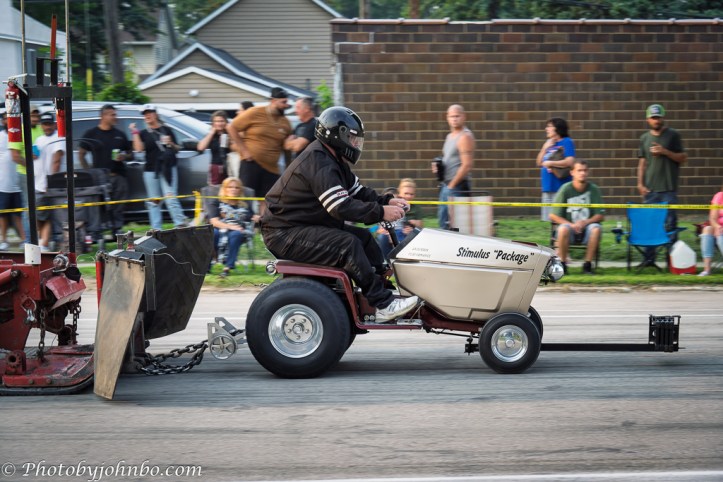
We only caught one slice of the action: the garden tractor pull. I am familiar with tractor pulls, big farm machines in modern agriculture, and antique steam tractors built in the early 20th century, but I’d never seen a garden tractor pull. From stock lawn tractors to dragster-style beasts, the pull showcased ingenuity, grit, and a whole lot of attitude. This photo story follows the rhythm of the event, where even the smallest machines made a big noise. Note the girl in the background, with her ears plugged, as Brent starts his pull. Ear protection is a must at these events. The objective is to see who tows the Red Iron sled the farthest in the tractor’s weight and performance class.

The sled has its own operator whose job is to keep the event safe from a load perspective. That small box in the center of the sled’s rail contains a 10,000-pound (4,536 kg) weight. As the tractor moves down the street, this box is geared to slide forward toward the tractor.
This process is known as weight transfer. At the start of the run, the weight sits over the sled’s wheels, allowing it to roll relatively easily. But as the tractor nears the end of the track, the box moves directly over the flat steel ‘pan’ at the front. This grinds the sled into the asphalt under immense pressure, generating a braking force that eventually overcomes the tractor’s power and brings it to a halt.
In this specific run, Brent pulled 261.76 ft (79.78 m) at a maximum speed of 18.3 mph (29.4 km/hr). While I won’t list these detailed stats for every tractor in the story, Brent’s Super Modified (1250 lb / 567 kg) class run serves as a great example of the power these machines can produce.

From this vantage point at the end of the run, you get a true sense of how far these tractors can pull. As the tractor moves down the track, the sled’s weight box steadily creeps forward, increasing resistance with every foot. The goal is 300 feet (91 meters)—a mark most classes won’t reach. Mini-Rods, the top-tier machines, sometimes push past 350 feet (107 meters). On the right, the track official in the white T-shirt represents the Gopher State Garden Tractor Pullers, the organization that oversees safety and scoring throughout the event.

The Stock class is where many young drivers get their start. These tractors are minimally modified, often close to what you’d find mowing a lawn—though the stakes here are a bit higher. Safety is taken seriously: drivers of stock-class tractors must wear helmets, long pants, and closed-toe shoes. For higher classes, a full fire suit is required. This photo shows a young puller preparing to compete, and officials who know the drill. The sled may be scaled down for garden tractors, but the challenge is real—and the pride just as strong.

After each run, drivers reflect on the pull. This stock-class tractor didn’t get far down the track, and the Red Iron sled shows why. The weight box—fully visible here—is loaded with weights and sliding forward as the tractor moves, increasing resistance with every foot of travel. By the end of the run, the box hadn’t traveled far, but the effort was real. In this sport, every inch demands more from the driver and tractor.

Before a driver can enter a tractor, they must decide which class to compete in. Classes are defined by the combined weight of the tractor and driver, along with engine power and configuration. This puller is confirming his setup before official certification. Notice he’s standing on the scale alongside the tractor—because in this sport, the driver’s weight counts too.

Criminal Complaint made multiple appearances at Claremont’s pull, competing in three different classes with three different drivers. This run shows the tractor mid-pull, digging in as the sled’s resistance builds. The machine’s bright paint and bold name drew attention all day, but it was the teamwork behind the scenes—drivers and crew—that kept it rolling. Whether this was Cory, Brad, or Scott at the wheel, the crowd was watching.

With flame graphics and a name that turns heads, Criminal Complaint is a crowd favorite. This photo captures one of its three drivers—Cory, Brad, or Scott—getting ready to pull. The oversized rear tires and dragster-style build hint at the power under the hood, but it’s the camaraderie that defines the day. In Claremont, tractor enthusiasts like them travel in teams, and every run is a shared effort. Teams travel sometimes two to three hours to get to a garden tractor pull. Note the girl in the background with her ears plugged, anticipating the noise that will soon envelop the track.

Not every machine on the track is a chrome-piped beast; many, like Scott’s “Old Dog,” carry the patina of a stock garden tractor with a few allowed modifications. From his attire—helmet, long pants, and closed-toe shoes—he competes in the Stock class. Scott is a true iron-man of the event, competing with multiple tractors across different performance brackets. To move from the 1,000 lb (454 kg) class to the 1,050 lb (476 kg) class, drivers often bolt on small lead weights (just visible at the right edge of the photo) to meet the division’s specific requirements. This ensures a fair fight, but once the chain is tight and the green flag drops, it’s all about how the driver manages the engine’s torque against the rapidly increasing drag of the Red Iron sled.

Pulling on asphalt is a high-stakes balancing act between power and equipment failure. When a seal blows or a line leaks, the event is halted for a safety cleanup. Because this is a city street and not a dirt track, the crew has to be meticulous. At the first indications of a spill, the cleanup team jumps into action with absorbent material and brooms to ensure the pavement is safe and dry before the next tractor is allowed to start. It would actually be an advantage to have oil on the track for upcoming competitors, as the oil would lubricate the sled pan, allowing it to pull more easily. We only saw one interruption because of an oil leak during our evening at the track.

The spirit of the garden tractor pull is rooted in family. Beyond the roaring engines and technical classes, the event is a multi-generational hobby where even extended families share the pits and the track. Ryan stays close to his niece, Hanna, as she prepares her tractor, “Just a Little Mower,” for its run. Even in the stock classes, the focus is real; as Hanna prepares to pull, Ryan offers a final bit of advice and a steadying hand before the weight of the Red Iron sled begins to transfer. The involvement here is a full-team effort—Ryan’s own children, Gracelyn and Tucker, also competed during the evening, showcasing how this sport truly becomes a way of life for the whole family.

As the sun dipped, the competition shifted to the Mini-Rod class—the top-fueled dragsters of the garden tractor world. Machines like “Money Pit” are built for spectacle, featuring the same visual DNA as their professional cousins: open engine layouts, aggressive stances, and massive rear tires. These custom-framed beasts are designed for one thing only—raw, unadulterated power. I didn’t meet the driver, Tara, but her performance was undeniable; her run easily shattered the 300-foot (91 m) goal. It is safe to say these machines have never seen a day of work in a vegetable patch.

The highlight of my evening was spending time with Richard Thron, the owner and driver of “Rattitude.” At over 80 years old, Richard is a testament to the sport’s lifelong appeal. He isn’t just a spectator; he’s a formidable competitor whose family remains deeply involved in the pulling circuit. His Mini-Rod—a sleek black machine with massive vertical headers—thundered down the asphalt for a massive 372.35-foot (113 m) pull, the longest I witnessed.
The competition between the Mini-Rods was fierce; Richard and Tara traded top spots across different weight classes, with both machines consistently shattering the 300-foot (91 m) mark that most other tractors couldn’t reach. Talking with Richard, I realized that for him, the pull isn’t just about the distance—it’s about the shared passion and the engineering challenge that keeps him coming back year after year. Watching him pull against the setting sun was the perfect conclusion to a day defined by power, family, and community spirit.
A Special Thank You
I’m grateful to Matt Larsen, President of the Gopher State Garden Tractor Pullers and organizer of 16 pulls this year alone, for taking the time to walk me through the mechanics of the event. His years of experience gave me the insight I needed to understand the invisible forces at play behind the Red Iron sled and those powerful garden tractors.
For those interested in the specific rules, weight classes, or how to get involved in the sport, you can find the official rule book and event schedule at the Gopher State Tractor Pullers Website here. Whether you’re looking to build your own “beast” or just want to catch the next pull, it’s the best place to start. For information on the 2026 Hogfest, it’s held traditionally on the first full weekend in August, which in 2026 falls on August 7-9. If you decide to attend the tractor pulls, be sure to bring ear protection, especially for your little ones. Keep an eye on the Claremont City website here for details.
About the photos: All images were captured with my Nikon Z7 II and, for one of the first times, I used the Nikkor Z28-400 f/4-8 VR lens. The images were loaded into Adobe Photoshop for cataloging and basic tweaks, including the new Adaptive Color profile that works only with RAW and DNG photos to intelligently analyze each RAW or DNG image. The tool adjusts color, tone, and contrast to suit that specific photo. It recovers highlights, opens up shadows, and balances contrast without touching the editing sliders. The AI analysis behind this tool provides a more natural starting point than the Auto button in the Develop module. From there, I exported the files to Luminar Neo for final tweaks. For those who wish to look at the metadata or pixel-peep in 2K HD, visit the gallery on my Flickr site here.
John Steiner
 Journeys with Johnbo
Thanks for a fun introduction to tractor pulling John.
It was a fun day, topped of by the phone conversations with Matt to teach me about the mechanics of the sport.
What an experience and fun. Thanks John!
It was a fun day with family and lots of noise. >grin<
😎
What a fun event!
Indeed it was, for families, it’s a great activity.
Lol that looks like some small town fun!
Indeed!!