February 2025.
London, United Kingdom.
Back in London for a second visit and a trip to Southampton to depart on a transatlantic cruise, we had one day to tour the city. In 2022, our tour was self-guided, but this time we wanted a more complete tour. Little did we know, we’d get the silent treatment. We often use Viator as a source for reliable tour excursions and decided on a “Taxi Tour hosted by an experienced London taxi driver.” As it turned out, he would drive us to a location, point us in the direction we were supposed to walk, and then wait by his cab until we returned, so he could drive us to the next stop. No narration, no history, no charisma, just a ride with a mostly silent cabbie.

Our first stop, Westminster, London’s ceremonial heart, greeted us with Gothic grandeur and a crush of tourists. Our taxi dropped us near Parliament Square, where Westminster Abbey rose in stone and grandeur. The crowds were thick, so some of my photos—including this one—were edited to remove distractions and let the architecture speak for itself.

We arrived ready to explore Westminster Abbey’s interior, but the queue looked like it might outlast our cruise. With a nod to practicality (and sore feet), we settled for admiring the façade and saving the inside for another day.
Westminster Abbey has hosted coronations, royal weddings, and funerals for nearly a thousand years—not that our cabbie mentioned any of that. Anchoring one corner of Parliament Square, the Abbey began as a Benedictine monastery around 960 A.D. and was rebuilt in Gothic splendor by Henry III in 1245. It’s been the coronation site for every English and British monarch since 1066, and its tombs hold the remains of kings, poets, scientists, and statesmen.
I learned all this (as I did for the entire tour) — the modern way: by Googling it as I reviewed the photos for this post.

Westminster Abbey precinct, just off Parliament Square, was packed—tourists flowing between the Abbey and government buildings. The Sanctuary’s Gothic Revival frontage marks the site of a monastic sanctuary, later reshaped in the 19th century. We admired the stonework and kept moving, saving our patience for the rest of the tour.

Nearby the Abbey, I spotted a British icon. Big Ben stands as stately as ever—the clock tower at the north end of the Palace of Westminster, officially named the Elizabeth Tower in 2012 to honor Queen Elizabeth II’s Diamond Jubilee.
The tower is part of the UK Parliament complex, where laws are debated and passed in the House of Commons and House of Lords. Though “Big Ben” technically refers to the great bell inside, the name has come to symbolize the whole structure—and, for many, British democracy itself.

As we passed St Margaret’s Church, I noticed an unusual design, a modern stainless-steel circle with a gold arrow hovering above. Mounted on the east side of the tower, it resembled a clock face but lacked the usual hands and numerals. Curious, I circled around to the west side and found a matching design. I concluded they were sundials, cleverly positioned so each would catch the sun at opposite ends of the day, no need for a full clock face in the shade.

Parliament Square was a who’s-who of British history, or would’ve been, if we’d known who was who. Statues of statesmen ring the plaza, each cast in bronze and posed with purpose. Our group of American tourists recognized a few (Churchill, definitely), but many were simply unknown to us. With our cabbie barely within earshot, locked in a heated debate with another driver over his choice of parking space, we relied on plaques, Google, and each other’s half-remembered history classes to fill in the gaps. In a future post, I’ll take a stately walk through the plaza and share some of the historic figures honored there.

Continuing our walk near the plaza, I was struck by the architecture of this beautiful building. When we got home, I learned the details: Methodist Central Hall, Westminster, was built between 1905 and 1911 on the site of the old Royal Aquarium and Music Hall. The Great Hall seats over 2,000 and has hosted the first meeting of the United Nations General Assembly in 1946.

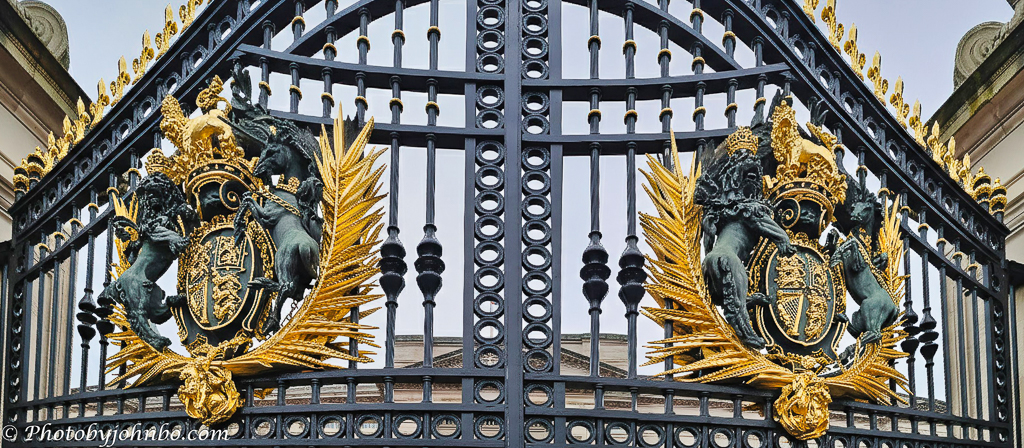
We left Parliament Square on foot, following the curve of St James’s Park toward Buckingham Palace. The route, part of the Princess Diana Memorial Walk, was quiet and scenic—a gentle promenade beneath leafless trees and scattered plaques. Our cabbie joined us for the stroll, still silent, leading like a reluctant chaperone. As the palace gates came into view, he peeled off, looping back to retrieve the taxi and meet us near the forecourt.

When we visited the palace in 2022, it was just a few weeks after Queen Elizabeth passed away, and that October day, the guards were not wearing their distinctive bearskin hats. In February 2025, we saw just a lone sentry in a grey coat standing watch beneath a quiet sky.

We stepped across the road from the palace and found ourselves at the foot of the Victoria Memorial, where gilded Victory gleamed above a sea of white marble. Google informed us that the monument anchors the plaza with allegorical figures—Truth, Justice, and Motherhood—gathered around a seated Queen Victoria, cast in imperial calm. Tourists milled about, snapping photos and posing on the steps, while our taxi driver was still off retrieving his cab.

We rode through city streets silently until we were dropped off at St. Paul’s Cathedral, its grand façade rising on the city’s oldest hill. The cathedral is a masterpiece of English Baroque, with twin towers flanking a columned entrance. We paused — not just for the photograph, but for the architecture and for the weight of history.

Walking downhill from the cathedral, I spotted a classic red double-decker (the 17) on its route. A perfect shot; the bus, the bustle, the bend in the road, marking the end of Fleet Street and the start of our own self-navigated adventure. Why would the taxi driver have nudged us to walk this stretch near Ludgate Circus? Maybe he knew what we didn’t yet: that this short descent would stitch together centuries. And maybe—just perhaps—our silent chauffeur knew that some stories are best discovered on foot.

Our taxi approached Old Change Court, where I snapped this photo as we rode by a Gothic memorial crowned with a golden star, marking the site of Saint Paul’s Cross, once the pulpit of England.

Our last taxi stop on the tour brought us to the Tower of London, just across the street from the hotel we stayed in back in 2022. The neighborhood felt familiar; the stone walls, the green lawn, even the modern glass buildings peeking over the battlements. This time, I didn’t need Google to tell me what we were seeing.
The Tower of London was built in the late 11th century by William the Conqueror to assert Norman power over the city. It was initially constructed as a fortress and royal residence. Today, it houses the Crown Jewels and remains one of Britain’s most iconic historical sites.

As we walked back from our photo stop at the Tower of London, we passed a familiar monument just steps from our 2022 hotel, which you can spot in the background on the right. The Merchant Seamen’s Memorial stands in quiet tribute to over 36,000 civilian mariners who died in both World Wars with no known grave but the sea. The original structure resembles a classical temple, with bronze panels listing the names of those lost in the First World War. Surrounded by trees and benches in Trinity Square Gardens, it’s a solemn reminder of the sacrifices made by those who kept Britain’s lifelines afloat.

This was our final photo stop on the taxi tour. Tower Bridge, dramatic as ever beneath a moody sky. It’s the image most people picture when they hear “London Bridge,” but that’s a common mix-up. The actual London Bridge is a more modest span just upriver, and its 19th-century stone predecessor was sold and relocated to Arizona in the 1960s. Tower Bridge, with its Gothic towers and rising roadway, was built in the 1890s to ease congestion east of the city. Today, it’s not just a crossing; a bridge built for horse-drawn carts now carries double-deckers and tourists.
And just like that, the taxi tour was over. Our driver — still silent, still mysterious—eased us back toward our 2025 hotel near Victoria Station. No commentary, no nods, just the occasional blink in the rearview mirror. We didn’t mind. The city had spoken plenty on its own. Those final views of London Bridge and the Tower of London rekindled memories of that earlier trip. It was time to shift gears; tomorrow, we’d head to Southampton to board the cruise ship and begin the next chapter of our journey.
About the photos: Most were captured with my Nikon Z7 II and Nikkor 28-400 lens or my Samsung S23 Ultra. The Tower Bridge photo was captured with my Sony RX-100 v5. Some images had distractions removed with the AI tools in either Photoshop 2026 or Adobe Lightroom Classic. You can view the photos in 2K HD and check out the metadata in the gallery on my Flickr site here.
John Steiner
 Journeys with Johnbo
I found this quite amusing, John. I do like a guide who speaks, but I seldom remember much of it afterwards so always end up in Google. And as you say, the architecture speaks for itself. It’s a beautiful city xx
Truth is, I always go online anyway because it’s so long after the tour that I get to the post that I can only hope to remember the highlights, as well.
Your taxi driver sounds very shy John, quite unusual for a London cabbie! The tour was lovely though and it is so nice to see so many beautiful photographs of the city that was my home for seventeen years 😊
He wasn’t shy when he was arguing with the other cabbie. >grin< Truth is, though we would have liked a narration, placards and other references were available for me to photograph, so at least I knew what to look up.
Thanks, Xenia!
I hope you didn’t give him a tip. 😀😀
He got a tip, but is wasn’t the usually overgenerous tip we leave for the best guides. 🙂
You sure saw a lot of London in one day! I really enjoyed all your beautiful photos of the city. I’ve never had a taxi driver that didn’t talk!
Thank you for your photo tour John. And I’m glad you weren’t silent!
Thanks, Anne!
😎
It’s unusual to find a London cabbie with nothing to say for her/himself, though actually guiding (historical facts and anecdotes etc) isn’t usually part of their brief. Anyway, if you’re anything like me you would only have taken in a fraction of the info and would have had to rely on Google later anyway!
True that (about having to do the research anyway.) It was a fun way to share the tour with the speech-deficient cabbie. >grin<
Great concept for a city tour and so much better than sitting open-air in the Big Red Bus while listening to information I will forget through a headset.
If I can even hear the tour guide speak in the headset… don’t even mention the music! >grin<
Unlike your cabbie, you give a great tour John, with just the right amount of backstory. I would love to see London and those beautiful and iconic buildings, especially Abbey Road, Big Ben, and Tower Bridge.
What a great gallery, John! Thanks for showing us around London sites.
London has so much history, it’s hard not to over-photograph. You should see the stack of photos I didn’t share. >grin<
Lovely gallery but sad to know about the silent treatment.
We took it in stride. At least, he took us to the major sites, so I got lots of photos.
It’s a common practice in India to hire a taxi to visit tourist places. Such services are provided by reputed companies and we are aware of the fact that taxi drivers are not guides, still they provide information.
We’ve also taken taxi tours where the guide provided historic and cultural information. It could be that this London cabbie just wasn’t the talkative type. >grin<