This week, Sofia hosts a challenge in one of our Looking Back series. She chose an early challenge, #20 – Doors. She writes, “You can perhaps focus on the history or stories behind the doors and doorways you pick.” You can read her entire challenge post here.
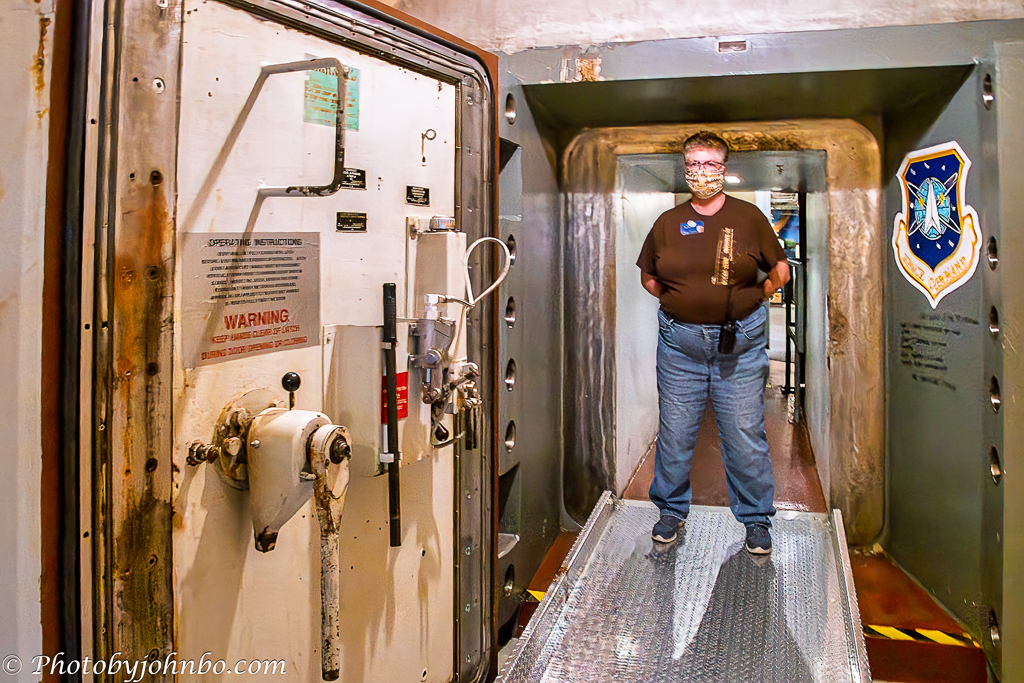
Sofia had me at history and stories, so I opened with two photos of some hefty doors. These massive slabs of steel and concrete guard the nerve center at one of America’s Cold War deterrents. In 2021, just after the release from COVID lockdowns, we visited the Ronald Reagan Minuteman Missile State Historic Site near Cooperstown, North Dakota, one of North Dakota’s operational missile silos that has been decommissioned and is now open to the public. The underground Launch Control Center (LCC) and the Launch Control Equipment Building are both protected by eight-ton blast doors designed to withstand nuclear shockwaves, intrusions, and even internal accidents.

The Story: The blast doors serve as the primary protective barrier for the facility. Each door is constructed from reinforced steel and includes internal layers designed to absorb shock and resist pressure changes. They operate on pivot hinges and are secured by hydraulic locking systems. The surface of these doors, in use since the facility opened in 1965, has signs of wear from regular use as the doors were opened and closed as shifts changed. These doors are designed to isolate critical areas and maintain structural integrity during emergencies or containment procedures.

Early one April morning, I noticed this 3-inch-long (7.6 cm) snail on the siding of the house we rented in Hawaii. It sat on the screen door of the ground-floor entrance. The screen door hinge is a standard 3-inch hinge.
The Story: According to my research, our visitor, the Giant African Land Snail, poses a significant threat to Hawaii due to its rapid reproduction, ability to consume over 500 plant species, and impact on ecosystems. It damages crops like papaya, banana, and taro, threatening agriculture, and competes with native snails for resources. The species can even carry a parasite that can cause human meningitis. I’m glad the door did its job and kept our potential guest out of the house.

El Morro, formally known as Castillo San Felipe del Morro, is a 16th-century fortress that has guarded the entrance to San Juan Bay, Puerto Rico, for over 450 years. Construction began in 1539 under Spanish rule, making it one of the oldest European fortifications in the Americas.
The Story: Nestled within the stone walls of El Morro, this weathered wooden door, its rusted latch and iron-gridded window, tells the story of a time when vigilance was constant and silence strategic. The door bearing the scars of salt and sun; each nail and plank of wood tells a story of colonial defense.

On our visit to the cliffs of Arcos de la Frontera, Spain, in October 2022, we stopped to see the Basílica de Santa María de la Asunción. Originally built on the foundations of a former mosque, the church began its reconstruction in the 15th century, its Gothic design absorbing Renaissance and Baroque influences over time. Unfortunately, the guide didn’t tell us we wouldn’t be able to view the interior due to the ongoing renovation (that she didn’t mention before our long climb up the hill).
The Story: Scaffolding blocks the basilica’s ornate entrance as workers in protective gear tend to its ancient interior. From what we could tell at a glance, the restoration effort appears to focus on interior preservation. Our guide had no information about the work in progress, but I noticed that it seems careless that the workers have leaned a ladder against the ancient doorway. The exterior designs and motifs around the doorway have endured centuries of sun, wind, and seismic tremors as they silently tell their own story.

The American Prohibition Museum offers a comprehensive look at the social, political, and cultural forces that shaped the Prohibition era in the United States. We visited the museum in Savannah, Georgia, in 2023. The only museum in the country dedicated solely to this chapter of history features exhibits, artifacts, and displays that explore the Temperance Movement, the 18th Amendment, the rise of speakeasies, bootlegging, and organized crime.
The Story: The doorway marked “Closed for Violation of National Prohibition Act” recreates the forced shutdown of establishments that defied federal law during the 1920s and early 1930s. The sign, nailed across the entrance to “Tristam’s Saloon,” demonstrates the abruptness and authority of Prohibition enforcement, when federal agents, often backed by court orders, padlocked saloons and distilleries across the country. It’s a visual reminder of a time when a simple doorway marked the boundary between legality and rebellion.
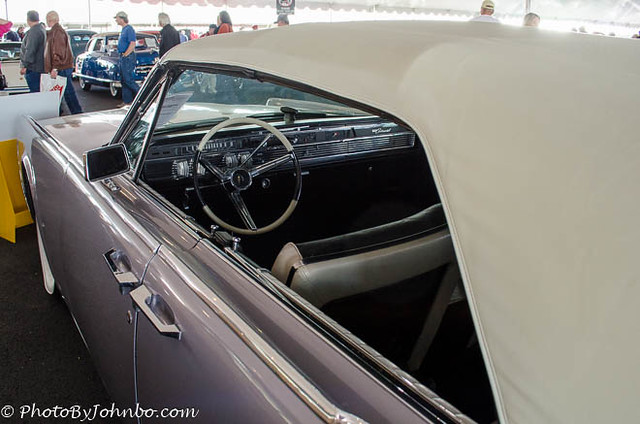
Long before the 1960s Lincoln Continental made them iconic, rear-hinged doors, known as coach doors, were a staple of early automotive design, borrowed from horse-drawn carriages to allow dignified entry and exit. In 2012, at a Barrett-Jackson Auto Auction in Scottsdale, Arizona, I spotted this unusually muted plum color example. The car’s doors framed the cabin like a grand entrance, opening outward with theatrical symmetry and reinforced the car’s role as a rolling symbol of power and poise. Presidents rode in them. So did moguls. The only thing missing with this car was the chauffeur; however, the message was clear: this wasn’t just transportation—it was arrival.
The Story: Over time, those rear-hinged doors earned a darker nickname: “suicide doors.” The term reflected safety concerns; if accidentally opened while driving, the doors could catch the wind and swing wide, posing serious risks to passengers. As safety standards evolved, manufacturers phased out coach-style rear-hinged doors in favor of forward-hinged designs, which latch at the rear edge for improved crash protection and structural integrity.

Conceived during the Great Depression and completed in phases through the 1930s, Rockefeller Center was the vision of financier John D. Rockefeller Jr., who imagined a “city within a city” that would fuse commerce, culture, and civic pride. In 2022, we walked along Fifth Avenue and passed the historic 630 address, one of many entrances that reflect the complex’s introduction of Art Deco elegance to Midtown Manhattan.
The Story: This gilded entrance is grounded by three golden doors with glass panels. The entrance is crowned with nine statues arranged in vertical columns, each symbolizing a foundational industry: salt, wheat, wool, coal, fish, cotton, tobacco, and sugar. These sculpted figures represent the raw materials that fueled global trade and industrial growth. Together, they narrate a story of economic interconnectedness rendered in bronze, stone, and symmetry.

In February this year, we visited Pontevedra, Spain, and the Catedral de Santa María de Tui. This Romanesque-Gothic structure, located in Galicia near the Portuguese border, was built between 1120 and 1225. The cathedral served both religious and defensive roles, evident in the fortified towers and strategic hilltop location we saw on our visit. For eight centuries, the church has guarded the frontier and guided pilgrims along the Camino Portugués toward Santiago de Compostela.
The Story: The cathedral’s entryway is an early Gothic structure featuring a sculpture of the Virgin Mary. Positioned centrally above the entrance, the figure is painted in soft blues and golds, emphasizing her role as protector and intercessor. The only color detail on the door adds visual focus and devotional significance to the otherwise wood façade.

In January, we visited The Ignite Sign Art Museum in Tucson, Arizona, which opened in 2018 with a mission to preserve and celebrate the history of signage, especially neon. Founded by longtime sign maker Jude Cook, the museum showcases over 350 signs from Tucson, the Southwest, and beyond. Lynn and I enjoyed the historically restored neon pieces, which highlight the craftsmanship and cultural impact of commercial signage once displayed above businesses in Tucson.
The Story: This blue door leads to the Museum’s backyard and serves as a playful tribute to the global neon community. Topped with the phrase “Oh, the Places You’ll Go! FOR NEON,” it features directional signs pointing to neon museums and attractions across the U.S. and abroad, from the Neon Museum in Las Vegas to the Neon Muzeum in Warsaw. Each sign includes the name and distance, emphasizing the widespread appreciation for neon art and its preservation.

A few days later, we visited the Mini Time Machine Museum of Miniatures. The unique museum offered us a journey into meticulously crafted worlds both real and imagined. More than 500 miniature houses, roomboxes, and dioramas spanning centuries and continents took Lynn and me on an exploration through time, culture, and miniature craftsmanship. From antique dollhouses dating to the 18th century to contemporary fine-scale creations, each exhibit is a study in detail, storytelling, and the art of small things.
The Story: One of the first exhibits is a miniature Scottish Regency façade that opens and closes to reveal the three-story house behind it. The display, one of the few that is not protected by highly reflective plexiglass, evokes the elegance of early 19th-century design. When the façade wall is closed, its symmetrical two-story exterior features a trio of distinct doors: carriage-style doors at street level, a stately main entrance flanked by twin staircases, and a balcony door above, opening onto a balustraded landing.
That wraps up my doorway tour for this week’s challenge, but if you’d like a closer look at each image, a gallery of these images is on my Flickr site here for those who like to pixel-peep or check out each photo’s metadata. Last week, Ann-Christine hosted the challenge “Found at the Fair/ Market.” Next week, Beth is our host. Be sure to follow her here so you don’t miss her challenge post, which will be published on Saturday at noon Eastern Time. For more information on joining with your own challenge responses, you can find the details here.
John Steiner
.
 Journeys with Johnbo
A fabulous gallery of so many wonderful doors John. A cross section of US history mingled with door of the world.
Thanks, Brian. I had to search a bit to find these doors. 🙂
Well worth the search 👍🏼😀
Wonderful doors. House guest is a fabulous description
Unwelcome house guest… even better!! >grin<
Good heavens John, what an amazing array of doors and incredible variety. I’ve been to rockefeller center a zillion times and never once seen that door!! And I loved the story behind the car doors – who knew?! Finally, the snail story is a bit scary!!! Terrific post.
Thanks Tina! I realized after my search that I found many more doors than I thought!
Doors, doors and more doors. The ones at the Rockefeller and sign museum are my favorites.
Thanks, Brad!! This is a fun challenge.
John, this is a great collection of doors! I enjoyed the images and the stories behind them.
Thanks, Beth!
Wow! So many doors and each with a detailed description. You did a great job, and this post was well worth waiting for.
Thanks, Anne!
😎
I love how you took this challenge to fit your style, John. Wonderful doors and an interesting read too, I’ve learnt a lot!
Thanks, Sofia!
What an interesting post – so many different doors and so many stories. I am so glad those snails don’t live here, the normal sized ones do enough damage in my garden! I love the Rockefeller Center doors – well the sculptures and their meaning.
I’m glad they aren’t a “thing” in North Dakota either!! Thanks, Jude!
You did a good job with this challenge – too – and I am so impressed by your story telling. I learned new things in every paragraph.
Thanks! It was fun doing the research on places we’d visited just to find out about their doors.
It shines through – your pleasue of finding out!
I too love doors and the stories associated with them their history John. Really great photos and well-told details, stories on each door. The International Building at Rockefeller Center entrance is superb!
We missed the entrance at 30 Rock, but happened by the Rockefeller International Building at 630 Fifth Avenue where this photo was taken.
Excellent~! Blessings to you.
You have found some unusual museum. Who knew there was a prohibition museum. Wonderful doors and stories. I do wonder, though, what the food the doors on the missile silos would do when everything above was destroyed. 😉
There’s that. They did have a stores of food that would sustain them for a prolonged period, but I don’t remember now how much food was kept in the underground area.
Oops. Sorry that comment should have read what good, not what food. 😀
I loved this post so much that I had to scroll through the pics and read it a second time! 😁
Thanks, Pepper! That’s high praise!
A fantastic variety combined with fascinating stories! Great post, John!
Beautiful doors!
Thanks, Pamela.
Great selections John. I love those ‘suicide doors’ on the Lincoln.
Thanks, John! I’d love to have one of those beautiful cars… but, alas, no garage space. >grin<
[…] Janet, Donna @Wind Kisses, Marsha @Always Write. Back row is Journey with Johnbo and far right is John’s wife […]