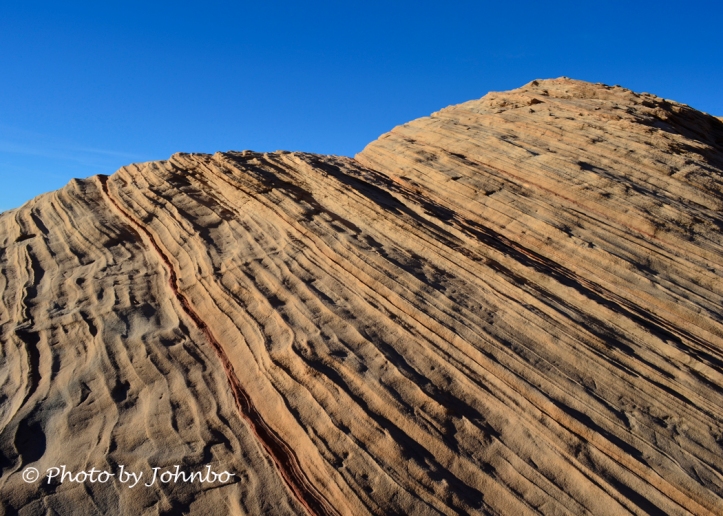
This week, the challenge is to examine your gallery or go on a photo walk. The objective is to find examples of photographs that feature compositional elements such as lines, patterns, or colors. There are times that you can find all three examples in one photograph, as in my opening photo of a sandstone outcrop. Centuries of erosion from wind and water have created the pattern of lines and earth tones in this sandstone. Photographing it at an angle allowed me to feature more of the outcropping, with the bonus that diagonal lines are typically more dynamic than vertical or horizontal lines. The angle of the sun in late afternoon provided shadows that enhanced the sense of depth in the variations.

The Great Basin Scenic Byway (U.S. Highway 93 in Nevada) may not be the loneliest road in America, but it shares pavement with one that is—U.S. Highway 50. We pulled into a roadside turnout, and I stepped briefly into the empty highway to capture this image. This photo features a leading line, the roadway, tapering from full frame to a slender ribbon; it draws the viewer toward the distant mountain and into the landscape’s quiet vastness.
While the highway serves as the visual anchor, the expansive negative space beside it conveys a sense of isolation and quiet resistance. It’s the “loneliness quotient” in full effect: The road is defined as much by what surrounds it as by what lies ahead. The surrounding wilderness, devoid of human interaction, serves as a counterpoint to the highway.

In the previous image, the leading line directed the viewer’s eyes into the photograph. In this example, the leading line of the path and fences direct the viewer to the subject, the pedestrian bridge featured in the picture. But leading lines aren’t always what lines are about in photographs. In this photo, lines also define the boundaries of the bridge. The visual perspective shortening also helps to organize the elements within. The color of the bridge floor also helps determine the bridge structure and introduces my next section, Colors in Compositional Structure.

The Lilac-breasted Roller stands out thanks to its vibrant colors, particularly the striking mix of lilac and turquoise feathers, which instantly catch the eye. The soft browns and greens in the background help accentuate the roller’s vivid tones. The contrast between the warm earth tones and the cool blues and purples gives the photo a sense of depth, making the bird feel three-dimensional. It’s as if Mother Nature understands her color theory.

Photographers often use contrasting colors, opposites on the color wheel, to make both colors appear more intense. In the photo above, however, the browns and muted greens of the landscape at Pinnacles National Park are largely analogous (close to each other on the color wheel). That brings a strong sense of harmony within the landscape. The sky introduces cool tones of grays and blues from the heavy clouds. The hint of blues and cool grays contrasts with the warmer, earthy tones of the land. The sunlight breaking through the clouds brings out the patterns and textures in the rock surfaces.

I didn’t think much about the patterns or design of the carpet in the Norwegian Pearl’s cabin hallways until I discovered that the pattern serves a definite purpose. The hallway floor covering features a bold use of bright, complementary colors (blue and orange/red), combined with harmonious analogous colors (greens and light blues) to display the aquatic theme. The repetitive design has a purpose that I didn’t perceive. After several times entering the hallway from our cabin and walking the wrong way down the corridor, I commented to Lynn that, yet again, we turned the wrong way. A voice from behind me, from a man walking behind us, told me the secret. The fish on the carpet are all swimming toward the front of the ship. From that point on, we didn’t make a wrong turn out of the cabin again.

Fort Jefferson, on an island in the Gulf of Mexico, was designated as Dry Tortugas National Park. The large fort has many compartments divided by arches, making them an obvious compositional tool through the receding pattern that culminates in a perceived vanishing point. Each arch acts as a frame, and its repetition creates firm leading lines that draw the eye deep into the image. This repetition emphasizes the linear perspective, making the corridor appear much longer and deeper than it might otherwise, creating a sense of depth and vastness within the structure.

One of the advantages of architectural photography is that the final photograph borrows the aesthetics of the architecture to enhance the picture’s composition. The designers of the staircase into the loft at St. Joseph’s Church in Sioux Falls, South Dakota, made it easy for me to showcase this concluding image. The curved leading lines of the elegant staircase and its ornate railing guide the viewer’s eyes upward. The flow, however, is contrasted by the repeating geometric patterns within the stained-glass windows. The rich, warm hues of the beige walls and golden stair treads are illuminated in a warm ambiance, while the cool, jewel-toned stained glass provides complementary accent lighting. Together, these elements of lines, repetition, and colors converge to bring out the designer’s grand and inviting creation.
Now it’s your turn to show us your work. Your challenge is to showcase examples of your use of lines, colors, or patterns in your compositions. Extra points will be allotted for showing examples that combine two or three of the categories of composition.
Last week, Tina’s challenge focused on how we all “Live and Learn.” Next week, Ann-Christine hosts. Be sure to follow her blog here so you don’t miss her challenge, which will be posted at noon Eastern Time on Saturday. If you’d like to submit your own responses to the Lens-Artists Challenge each week, but aren’t sure how to get started, check here.
About the photos: I’ve selected these images from my gallery, reaching back to 2013. If you are interested in the camera or lens used for any given shot, all the photos, including metadata, are posted on my Flickr site here. In the album, I’ve included some additional images that incorporate lines, colors, or patterns in their composition. All images were processed in Adobe Lightroom Classic and Luminar Neo. AI technology was used in some pictures to remove distractions.
John Steiner
 Journeys with Johnbo
[…] Lens-Artists Photo Challenge #359 is ‘Tools of Photo Compositions: Lines, Colors and Patterns’.The harbor of Le Conquet at low tide during sunset, as equestrians pass by. To say I was surprised when I spotted the horses, is an understatement. […]
[…] John’s turn to host the Challenge, and his theme is ‘Tools of Photo Composition: Lines, Colors, and Patterns‘. ‘This week’, writes John on his blog, Journeys with Johnbo, ‘the […]
[…] Lens-Artists: Lines, colours, patterns Johnbo asks us to explore these tools of photo composition. […]
Many thanks, John, for this v. interesting challenge. Plenty of food for thought in your photo gallery.
https://tishfarrell.com/2025/08/05/after-the-harvest-of-stubble-and-straw/
I enjoyed looking at your views of the harvested fields. Great examples for the challenge.
Many thanks, John 🙂
This was an interesting and enjoyable challenge, John. Initially, I thought I might find only a few pictures that would work, but I found many more. Your images really model the compositional tools well. Here’s mine: https://joannemasonphotography.com/lens-artists-challenge-359-tools-of-composition-lines-and-patterns/.
Thanks, Joanne! I’ve already seen your gallery. It’s stunning!
[…] of photographs that feature compositional elements such as lines, patterns, or colors.”– John’s Lens Artists […]
[…] post is for the Lens-Artists Challenge by John. #359: Tools of Photo Composition – Color, Lines and […]
[…] very informative and inspired challenge this week is – Tools of Photo Composition: Lines, Colors, and Patterns, composition guidelines that are invaluable for both new and seasoned photographers. Visit his post […]
Thanks for your challenge, JohnBo. I appreciate the hints about color, line and pattern. Here are my examples: https://fakeflamenco.com/2025/08/05/mark-the-pattern-with-lines-and-color/
Thanks, Rebecca! I’ve already visited your site and there I listed my favorites!
You are diligent in answering all your commenters. So kind of you.
[…] Lens-Artists: Lines/Colors/Patterns […]
[…] Lens Artists Challenge […]
[…] Lens-Artists Photo Challenge #359 is ‘Tools of Photo Compositions: Lines, Colors and Patterns’.Long leading lines, nice shapes etc are pretty obvious to use when building a nice frame. But what about chaos? Can that be appealing too? A field with spiderwebs, wet by the fog. A photo from almost 30 years ago, taken in Brittany at St. Samsom-sur-Rance, near Dinan. To see it at its best, click the photo please. […]
[…] Many thanks to John for this challenge Lens-Artists #359 – Lines, colors and patterns […]
[…] week’s theme for John’s Lens Artist Photo Challenge is Lines, Colours and Patterns. I have decided to just focus on Leading lines in churches. It is a […]
Here is mine for this week. https://wanderingteresa.com/leading-lines-churches/
Thanks!
[…] Sharing for Lens- Artists: Tools of Photo Composition […]
[…] you John (journeyswithJohnbo) for this invitation to refresh my understanding of these three tools of […]
[…] From JohnBo our challenge leader this week, […]
Gorgeous unique images! Here is my share for this week https://yourlifeasartphotography.com/2025/08/06/lens-artists-challenge-359-lines-colours-patterns/
Thanks, Pamela!
Wonderful challenge, wonderful examples!
Thanks, Dawn!
[…] Lens Artist Challenge this week is brought to us by Johnbo @ Journeys with Johnbo. He’s explained it well and we’re looking for photos that feature compositional […]
Here’s mine, great challenge
https://travelswithali.com/2025/08/07/participate-in-the-lens-artist-challenge-capture-lines-patterns-and-colours/
Thanks, Alison!
[…] Posted for Lens-Artists Challenge – Lines, Colors, and Patterns […]
[…] Lens-Artists Photo Challenge #359 is ‘Tools of Photo Compositions: Lines, Colors and Patterns’.A sunset over the Galgenwater in Leiden. A warm Summer night, with lots of boats cruising the canals. In the background the replica of the windmill of Rembrandt van Rijn’s father. […]
[…] Thank you John for continuing to emphasize the tools of photography that help make interesting and worthwhile images! https://photobyjohnbo.com/2025/08/02/lens-artists-challenge-359-tools-of-photo-composition-lines-col… […]
Great examples and explanations that helped me decide what to feature. That bird is gorgeous, and the road into the distance is stunning. Here’s my addition to the fun.
https://lindylecoq.com/2025/08/07/lens-artists-challenge-539-lines-colors-patterns/
Thanks, Lindy! I like to feature basic photographic rules in my challenges.
[…] More of the Lens-Artists Photo Challenge: Tools of Photo Composition Lines Colors and Patterns. […]
Wonderful examples with helpful explanations. The sandstone formation and the bright bird are especially appealing; the carpet rather hideous but I see it would serve me well as I’m directionally challenged. I started my post with all three, and soon ended up with so many images that I had to cut it back to just the ‘lines’ portion: https://elizabatz.wordpress.com/2025/08/07/elements-of-design-lines/
[…] week we are looking at lines, colors and patterns or a combination of the three. John from Journeys with Johnbo is hosting and has some wonderful images on his […]
Here is mine for the week
Thanks, Nora!
Here is mine, a great challenge! https://joehahnenfeld.wordpress.com/2025/08/07/lens-artists-challenge-359-lines-colors-and-patterns/
[…] This week John invites us to explore some of photography’s compositional elements – such as colour, lines and patterns. Here’s a link to John’s original post. […]
[…] week’s Lens-Artists Photo Challenge #359 is ‘Tools of Photo Compositions: Lines, Colors and Patterns’. Photography is about seeing. But what do you see? I can only talk for myself. It all starts with an […]
[…] Lens-Artists Photo Challenge: Lines, Colors, Patterns […]
Great challenge well exemplified and explained. As usual I learn something too! The Lilac-breasted Roller is my favourite, but they all are brilliant. When we travelled to Alaska with Norwegian Sun, there was another guest explaining the carpets pattern so us as well.
Thanks, Ann-Christine! I noticed the newer ships have a much more subdued carpeting in the cabin hallways, and no “front of ship” indicators. >frown<
I have nothing to compare with – but I liked the thought.
What a stunning finale, JS! The way you’ve captured the harmony of curves, patterns, and contrasting hues feels like a visual symphony. That staircase doesn’t just lead the eye—it lifts the spirit. A beautifully layered composition that truly celebrates design at its finest.
Thanks, Philo! All I did was attempt to capture the architect’s vision. >grin<
And they turned out so beautiful, John.
Thanks, again, Philo. I reviewed your post and tried to comment but after using two browsers in my attempt, it kept me in a loop of “You must log in to comment.” I’d log in, then the screen would refresh and tell me I must log in.
In any case, my comment was simply that your beautiful onion photo reinforces my belief that Mother Nature knows her color theory. >grin<
Thank you, John.
I understand better, because this happens to me regularly on many of the other blogs where I wish to comment. It happens with Tina schell’s blog posts too. She too experienced this problem, when she wished to leave a comment on my post. I get frustrated because I can’t post, my comments. WP is of no help. I guess it’s one of the WP glitches.
Thanks a ton for your kind words, John.
I don’t recall ever having that problem before. I noticed that Egidio and others didn’t have the problem, but it’s clearly an issue with WordPress.
Now I remember, I can’t post my comments on Edigo’s article from my mobile, but I can from my laptop.
[…] This post is part of John’s Lens Artists Challenge #359-Lines, colours, patterns […]
My contribution
https://philosophyvia.photos/2025/08/09/fine-line-lens-artists-challenge-359-tools-of-photo-composition-lines-colours-patterns/
[…] Thanks to John over at Journeys with Johnbo for this Lens-Artists Challenge […]
[…] week I am combining the Lens-Artist Photo Challenge with Terri’s Sunday Stills Monthly Color Challenge […]
[…] It’s been a while since I’ve participated in a WordPress Challenge so thought I’d jump back in with this dizzying contribution to the Lines, Colors and Patterns for Len-Artists Challenge #359. […]
It was great to cross paths with your challenge – it’s nice to participate again after several years away from blogs and blogging. A nice selection here – my favorite is the Lilac-breasted Roller. More birds, please. 🙂
My contribution: https://www.bobramsak.com/vertigo-at-the-hotel-bristol-palace/
Thanks, Bob! Will do (on the birds).