This week, Ann-Christine introduced a challenge series that will be featured regularly going forward. “Looking Back” challenges feature a previous challenge topic. In this case, “Creativity” was the 42nd topic of the Lens-Artists Challenge. In that original challenge, she wrote, ”… is the use of imagination or original ideas to create something new or somehow valuable – inventiveness. The created item may be an idea, a scientific theory, or even a joke; or a physical object, maybe a new invention, a literary work – or a painting.” This week’s Looking Back Challenge can be found here.
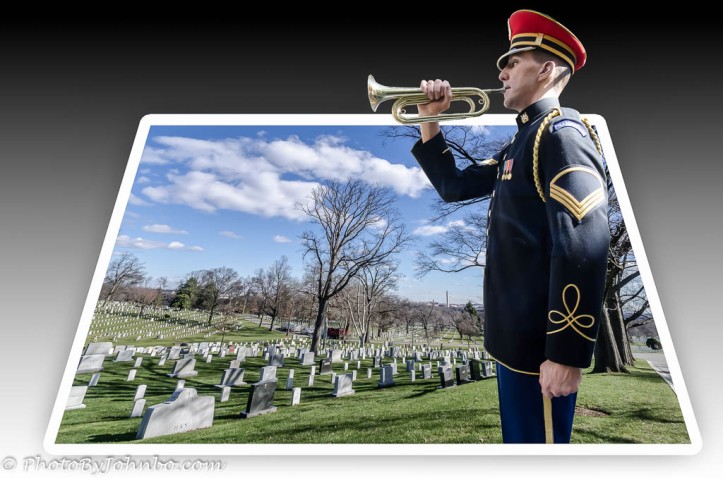
In honor of our nation’s Independence Day, my opening image features a composite photo I created in 2018. At that time, many people were posting Photoshop-enhanced images that made the subject appear to “pop out” of the frame. For a time, I tried these photo manipulations using Photoshop Elements. I discovered that I enjoy manipulating the photos as much as I enjoy taking them.

In Western North Dakota, an artist who works in scrap metal recycles the junk acquired from others to build sculptures featured on a county highway in southwestern North Dakota. The Enchanted Highway is a great side trip, just a short detour off the Interstate.

Gary Greff is the creative genius behind the Enchanted Highway, a county road running from Exit 72 on Interstate 94 south to Regent, North Dakota, the unofficial end of the highway. Seven completed sculptures are featured in small parks along the 32-mile (52 km) stretch of the road. Probably the most complex of the sculptures is “Fisherman’s Dream”, a view from under the lake of a giant Northern Pike leaping from the water to catch a dragonfly while the surprised angler looks on.

Since retiring and wintering in Arizona, I’ve become a fan of the Great Southwest and the Sonoran and New Mexican deserts. In Albuquerque, I found this sculpture by Luis Tapia in the Albuquerque Museum. His art is featured prominently there.
This work, in warm, bright colors, is laser-focused on my love for both the southwest and classic car culture. The dashboard, the highway scene, and the religious figures are all hallmarks of Tapia’s distinctive style, which blends traditional New Mexican santero (saint-making) techniques with contemporary themes, especially those related to lowrider culture and car customization.

At the Albuquerque Museum, near the work “Carrita”, I saw this artist’s view of Albuquerque. Before I noticed the city name in the upper left, I thought it was a painting of Phoenix, which is also nestled in a mountain valley. Gemini told me it is likely the work of Earl Biss, but Gemini was unable to provide more information beyond an incorrect biography of Mr. Biss. As JohnRH noted in the comments, it’s the work of John Fincher. The museum’s website had a nice biography of Earl Biss, quoted here earlier, but there was no such bio for Mr. Fincher. Gemini provided this info: “John Fincher (1941-2024) was an American Postwar & Contemporary painter, monotype maker, and draftsman, known for his realist and sensuous art that often explored the natural and cultural landscapes of the American West. He passed away in August 2024.” Copilot corroborated that basic bio.

In 2013, we visited the Phoenix Botanical Garden, which was then featuring a display of Chihuly’s glass. In this artwork, the red glass reeds appear to emerge from the desert floor alongside the native cacti and desert vegetation. I could have stepped to the right to see a clearer photo of the reeds, but in the camera’s viewfinder, I noticed the prickly pear cactus in the foreground. To me, they looked like people in front of me also enjoying the sculptures.

Over the years, I’ve attended some Native American powwows. A Native American powwow is a colorful social gathering that celebrates Indigenous culture through dance, music, and community. Participants wear elaborate regalia featuring intricate beadwork, feathers, and traditional designs that often hold deep cultural and personal significance. I decided that this photo might be suitable for an experiment in creating photos modeled after the Adamski Effect.
The Adamski Effect is a photographic technique that creates a distinctive streaked or blurred background while keeping the main subject sharp and in focus. It can be achieved by using a slower shutter speed while panning the camera to follow a moving subject or by separating the subject and background in post and blurring the background before reintroducing the subject into the blurred background.

Since Photoshop and other photo editing software have developed the AI necessary to replace skies in images, I found the technique helpful in adding more vibrant skies to pictures taken on cloudy, gray days. In the interest of journalistic responsibility, I always identify sky replacements in my work when I share on my blog. This image of Masaya, a volcano in Nicaragua, was done just for fun. I found this storm-filled sky in a collection of skies provided as part of my membership in Skylum Software’s X Membership.

In 2020, I was binge-watching YouTube videos and exploring different ways to experiment with my photography, partly to distract myself from the COVID-19 quarantine. I discovered Twirls, a photographic technique that manipulates an image using Photoshop by applying a series of filters in a more complex manner than I previously used to create Adamski effect emulations.
At that time, I was using Photoshop Elements, so I had to experiment to convert the YouTube demonstrations to match the different menus and options in Elements. I finally figured out the sequence and created several of these images just for fun.

Another project I started during the COVID-19 era involved experimenting with creating day-to-night conversions, sometimes using night sky replacements and sometimes simply adjusting the image’s exposure to darken it. In this case, I used the North Dakota sky I captured when the comet Neowise appeared in July 2020. I then blended that sky with an image taken at a resort in Mexico.
Astronomers would spot the deception quickly. Both the North Dakota sky and the sunset shot at Mazatlán were taken with the camera pointing west. In Mazatlán, however, Neowise would have been in the northwest sky, not the western sky, as it appeared when I captured the image in North Dakota. To make the resort scene appear as if it were captured at night, I simply lowered the exposure of the original image.

In recent months, I’ve discovered YouTuber Jamie R. Mathlin, who teaches techniques in Lightroom and Photoshop. He has a series of videos that teach day-to-night conversions. I’ve learned a lot from his videos as I’ve emulated the style of his work. As we started a tour down a narrow Barcelona street, I captured a photo of the old town area through the windshield of the small tour van. Mathlin teaches how to illuminate streetlights and the areas adjacent to and below them using radial filters to adjust exposures in small areas. The only thing I didn’t do was replace the sky, as the city lights of Barcelona would have washed out any stars.
With this night image, it’s time to say “good night” to all and get this challenge response “put to bed,” as the journalists might say. Thanks to Anne for hosting the “Reflections” challenge last week. Next week, we honor the July 4th holiday by taking a short summer break. We’ll be back on July 12 at noon Eastern Time with a guest host as SH challenges us. If you’re new to the Lens-Artist challenge scene and would like to respond with your own photos, look here to find out how to get started.
John Steiner
 Journeys with Johnbo
Wishing you a happy celebration day tomorrow, John. You’ve certainly mastered the art of manipulating your photography, to great effect. I love all of these xx
Thanks, Jo!
You are very creative in your editing and the results are great, I enjoyed them all, but this was my favorite A Native American boy at a powwow
Thanks, Ritva! I enjoy the editing process.
Some fabulous works here by yourself and others John
Thanks, Brian!
OUTSTANDING!!
Thanks, GP, your comment is appreciated!
Fantastic gallery! That Native American photo is beautiful. You got the effect perfectly.
Thanks, Egidio! I am particularly proud of my implementation of the effect. It’s probably the best I’ve done.
John, what an amazing collection of creativity! I love the art that you have featured and I always enjoy your creative photography edits. Happy Independence Day!
Thanks, Beth! Enjoy the holiday!
Some interesting examples of creativity, John. I like your treatment of the pow wow picture.
Thanks, Sue! One of my favorites!
Thanks for the fun and creative tour John. I enjoyed the metal sculptures, and have seen the Chihuly glass art. My favorites are the twists and day to night conversion. Kudos on your photo editing skill and creativity.
Thanks, Brad. I really enjoyed the two trips we made down North Dakota’s Enchanted Highway. Greff is a true artist in junk.
It looks fun.
I really like that Eric Bliss painting and enjoyed all your edits. Some I’d seen before but it was good to see such a wide selection together.
Thanks, Sarah. Sometimes with these challenges, I feel like I don’t ever do anything new. >grin<
I know the feeling!
Wow, your creativity shines in the editing process. Also your determination to learn and complete comes through as you edit. Great work John!
Thanks, Anne!
😎😎
I really like that Eric Bliss painting and I thoroughly enjoyed all your edits – I always do! You are very creative and versatile with the software. The Adamski I tried once after you had shown it in a post, but it did not turn out the way I wanted…Oh, I wish I could have some lessons from you! I will check out that YouTuber Jamie R. Mathlin. Turning day to night would be nice to learn.
My favourite? The native American boy. That is a wonderful picture.
Thanks, Ann-Christine. JohnRH let me know if incorrectly attributed the work to Earl Biss. It is by John Fincher.
Thanks! I like it anyway…;-D
Some wonderful creative images John, I especially love the Adamski effect and the day to night conversion 😊🌙
Thanks, Xenia!
Some wonderfully creative work John. I loved the scrap metal creations!
That is a fun 32-mile drive on the Enchanted Highway! Thanks, Tina.
Great posts – love all of your editing creativity!
Thanks, Nora!
Great selections. Varied and intriguing. I love the composite salute at the beginning. For a number of years I owned Land Of The Free, Home Of The Brave by Earl Biss, a serigraph. https://www.artbrokerage.com/Earl-Biss/Land-of-the-Free-Home-of-the-Brave-1991-Huge-131055 One’s eyes are drawn to the impressive chiefs and headdresses, then you look down and see the chains. Land of the free indeed.
Your ‘Biss’ appears to be: The Burning of Albuquerque by John Finch. One example: https://www.flickr.com/photos/43619751@N06/14906649403/
Fincher. 🙄🤷♂️😜
Thanks for the tip. Neither Google, Copilot, nor Claude.AI got it right. A correction is provided.
I even wrote the museum and email asking about the painting, but got no response.
Indeed! Thanks, again, for the correct artist’s name.
Creativity is a tall order, which you filled with panache.
Thanks, Rebecca!
Although the artists and their work that you showcased here are perfect for the challenge, what I really love is your creativity and boldness to try something new (with very cool results, by the way). Last one is my favourite, I might give this a try 🙂
Thanks, Sofia! I’ll try (almost) anything once. >grin<
Interesting
Nice gallery, John. I loved the artwork by the Albuquerque artist. The Fishermen’s Dream was funny!
The Enchanted Highway has many fun and funny subjects.
Wonderful post. The introductory image is an exception John. You use photo softwares very well.
Thanks, Rupali! I do enjoy editing photos.
Wow, John, you are so good at this.
Thanks, Teresa! I really enjoy editing.