This week, Sofia challenges us to demonstrate how our photos can have a cinematic feel. She writes in part, “…Emotion, mood, story. All things that can be accomplished with a few tricks like high-contrast light and shadow, layering and depth, interesting colour schemes (or monochrome), sense of movement, location.” You can read her entire challenge post here.
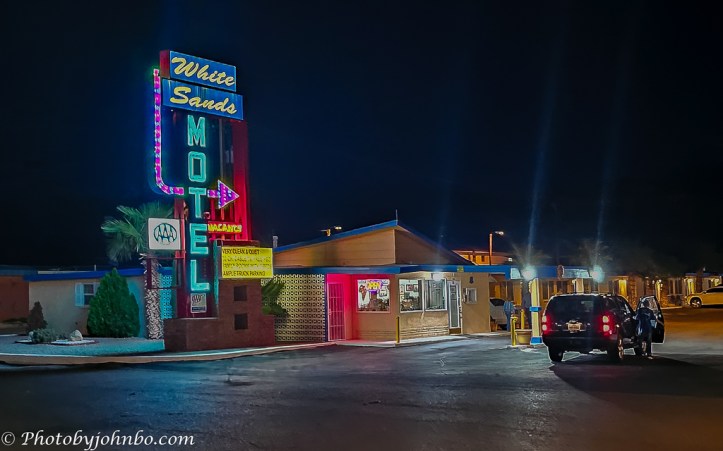
My opening photo features a scene that could be from a period movie: the arrival at a motel for the night. This mid-20th-century motel features a modest yet inviting design, featuring retro signage with neon lighting to catch the eye of passing travelers. The signage on this motel is known as a Googie sign (not Google) that helps define the era. I will post about those exuberant and eye-catching Googie signs in the future.

Lighting, or lack thereof, can set the mood of a shot. Though the Metro is well lit at the stops, I used a telephoto lens to capture the arrival of a train while it was still approaching the station, focusing on the headlights and their reflection on the ceiling.

Most of my choices for this challenge response would be “establishing shots” that introduce the viewer to the story in the film or photo series. Typical of establishing shots is a foreground frame, in this case, the shoreline with overhanging tree branches; a midground featuring the lake with a leading line allowing the eyes to wander toward the city; and the city skyline in the background.

On a stop in Morlaix, France, we walked down a street in the old part of the city and captured the railway viaduct and an old church. This photo, taken in the daytime, required extra processing. One characteristic of movies, especially older flicks, is that often outdoor scenes were shot in the daytime with exposure adjustments to simulate night photography. The photo above exemplifies using modern tools like Adobe Lightroom Classic and Luminar Neo to convert a daytime exposure to a blue hour shot. In a future post, I will explain the process along with before and after photos for comparison.
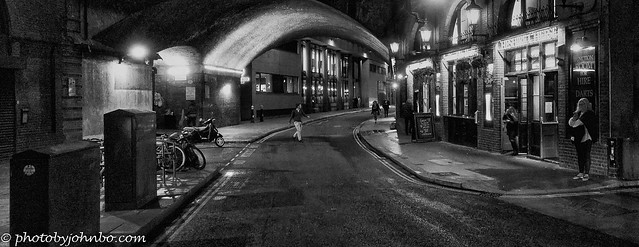
Black-and-white is an excellent medium for storytelling without the distraction of color. The juxtaposition of light and composition can create somber or joyous moods. I cropped the image into a wide-screen panorama and then converted it to black-and-white using Silver Efex 2. The wide image mimics 70 mm Ultra-Panavision 70, MGM Camera 65, or the earlier Cinerama three-projector wide screen systems.

Alaskan landscapes are beautiful in black-and-white or color. I once posted images from Alaska converted to black-and-white. This low-key backlit image was taken from a cruise ship on the Inside Passage, a coastal route that weaves through islands and fjords, and is one of my favorites.

I am concluding this cinematic challenge with a high-key image of kayakers paddling into the sunrise at Lake McDonald in Glacier National Park. Sofia’s challenge made me stretch a bit to find photos that would be good examples for cinematic storytelling. I’ve shared these photos on my Flickr site here as they are better displayed on a dark background.
I enjoyed your responses to my Go-To Places challenge last week. Next week, Ritva is our host. Be sure to follow her here so you won’t miss her post at noon Eastern time on Saturday. If you’d like to respond to our challenges but aren’t sure how to get started, check here.
John Steiner
 Journeys with Johnbo
You’ve found perfect photos for the challenge, John. I love your opener, and the train coming in. The Alaskan landscape is superb and it was nice to see London again.
Thanks, Sofia! It was fun to look at my gallery in light of the cinematic feel.
John your landscape photography are not images … IT IS ART! Beautiful work! Thank you John.
Thanks so much, Sergei! That’s a wonderful compliment!
Great images John, I like the night shot in color, especially the first one. Also London at night has a great movie vibe
Thanks, Ritva!
Love the motel. The image is so sharp and the lighting is perfect. All very cinematic.
Thanks, Marie! It’s probably my favorite shot in this series.
All fantastic shots, John. London and Morlaix would be perfect for a crime movie, I imagine. The Alaskan landscape in black & white is breathtaking and the metro shot has IMO a fascinating futuristic touch. I love your detailed and always educational narrative including the description of the techniques you used!
Thank you, Yanaj *
Wow! You’ve got some amazing shots here. That railway viaduct at night is amazing! Thank you for taking me along for the process.
Thank you, Violet!
This is absolutely a great response for this challenge John. I especially liked your neon shot just because I like neon. The rest are amazing choices. Well done!
Thanks, Anne! I wish there were more neon signs still in use!
😎
John, these are all great. My favorite is the the White Sands Motel. It looks like the beginning of a 50’s movie. I really like the ones in black and white, too.
Thanks, Beth! Sofia had us all thinking about the cinematic nature of our photography!
Nice story John. I like the White Sands Motel sign
Thanks, Brian! Fun challenge this week!
Wonderful theme: choose the kind of photos which would n9t be out of place in a movie. Your examples could also be good choices for the posters
Thanks, I. J. A movie poster would be a fun way to play with the photos! Maybe that’s a project for a couple of these. Thanks for the idea!
Great choice of images and interesting commentary on why you chose them and how you edited them to increase the cinematic effect. I love the opening shot of the White Sands Motel, the metro in Washington and the back-lit Alaska scene in particular. And I’m looking forward to hearing more about your editing process for the Morlaix shot as that’s something I fancy trying 🙂
Thanks, Sarah! It was fun finding these and tweaking a bit, if needed for the cinematic feel. Sofia picked an interesting challenge theme.
Very creative as always John. I loved the way you turned day into night in the France image and also loved the oncoming train. terrific!
Thanks, Tina! I’m really enjoying doing the day-night conversions, even though they take a lot of time.
These are fantastic photos and examples of cinematic images John! I particularly like the Googie motel and back lit mountains over lake ones.
Thanks! This was a fun challenge to work on!
Agreed.
Love the vintage motel!
It’s an example of one that I discovered in my unprocessed photos that turned out to be one of my favorites.
Wonderful images for the prompt John, I especially love the way you captured the motel at night 😊
Thanks, Xenia!
excellent variety for the theme and I liked the hotel opening ohoto the most – and look forward to hearing more about Googie signs….
~Yvette
Thanks, Yvette! It was fun learning about Googie signs and even Googie architecture. I’ll save the surprise for later. >grin<
great – I will look forward to the post when it unfolds
Such a stunning reel of moments—each frame whispers its own quiet screenplay.
From retro motel vibes to Alaskan silhouettes, it’s visual storytelling.
The Googie sign mention? A scene-stealer!
Thanks, Philo! I learned about Googie signs (never heard the phrase before) when I was doing ,my least bit of research about the history of the motel.
Welcome, John
Magnificent, John! The opening image made me think of Grease. Every single photo is a work of art.
Thanks, Egidio! That’s high praise!
A wonderful selection for the challenge.
I love the first Retro scene in colour. I’d probably never see that here in Australia these days.
I also like the B&W backlit scene.
Thanks, Vicki! The only thing that gives the scene away is the current model SUV instead of a classic car from the 1950s. 🙂
I didn’t even notice the modern car to be honest, John. I just loved the coloured lights and old-fashioned sign. Just goes to show sometimes I miss what’s right in front of me. 😀
I do love that opening shot John and then as I was going through it was look ooh I like that one and yeah I like that one too, far too many good ones John. Great cinematic shots.
Leanne, that’s high praise! Thank you!
I love your spooky night shots; they suggest so many stories…
Thanks, Elizabeth!
lovely moody ambiences here!
regards Thom
Thanks, Thom!